Ruffled Feathers Parrot Sanctuary Inc.
Where Hope Takes Flight


I Found a Baby Squirrel. Now What?
A complete, no-panic guide to baby squirrels in Kentucky and southern Indiana
Part 2 of the Ruffled Feathers Parrot Sanctuary “Found a Baby” series.
Read this part before you do anything else
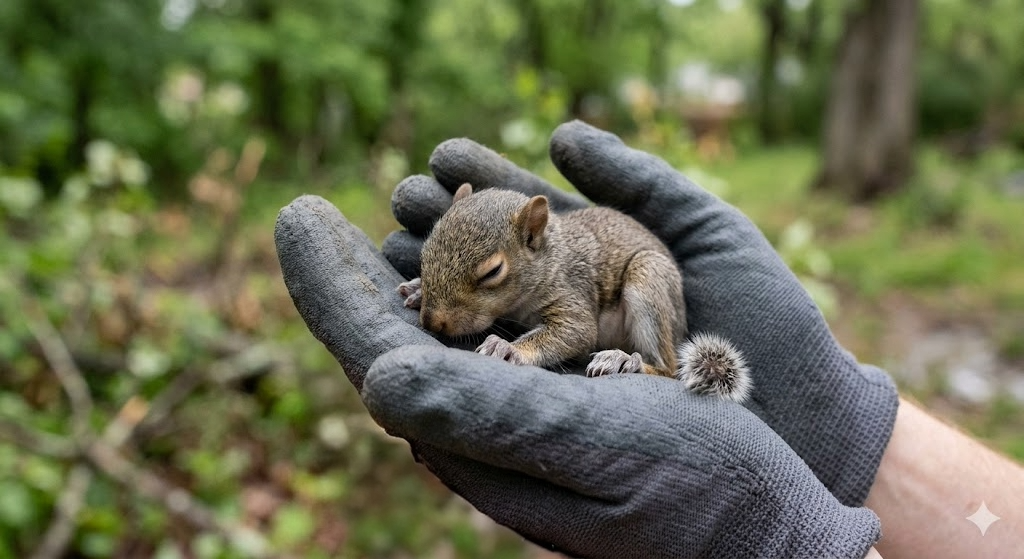
If you have found a baby squirrel, take a breath before doing anything else. The most important thing to know is that mom is usually still nearby. Most of the time, when you’ve found a baby squirrel on the ground, it has not been abandoned. Instead, they were displaced. That is a very different problem with a very different solution, and most of the time the right solution is to reunite it with mom before she moves on.
Step 1: Found a Baby Squirrel? Try to Reunite It With Its Mother
Why reunite first?
If you have found a baby squirrel, this step gives it the best chance of survival.
If a squirrel mom can collect her baby, she will. More importantly, that baby will grow up better with her than any rehabber can raise it.
Even if the baby is cold. Even if it has been alone for a couple of hours. Even if you have already touched it.
Mom does not reject babies over human scent. In fact, that is a myth.
Here is exactly how to do it.
Step 1a: Confirm the Baby Is Not Injured
First, make sure the baby is safe to attempt re-nesting.
If you see blood, visible wounds, a broken limb, cold stiffness, fly eggs (yellow-white grains stuck in fur), or maggots, skip to Step 3 immediately.
An injured baby needs a rehabber, not re-nesting.
Found a Baby Squirrel That Is Cold?
Step 1b: Warm the Baby Up First
Before anything else, warm the baby.
Because of this, a cold baby will not cry loudly enough for mom to hear it.
Put the baby in a shoebox on a soft cloth with a heat source on one side only. For example, use a low heating pad under the cloth, a sock filled with uncooked rice microwaved for 30 seconds, or a warm water bottle wrapped in cloth.
Keep half the box warm and half at room temperature. That way, the baby can move off the heat if needed.
Give it about 30 minutes to reach body temperature.
A warm baby is a loud baby. Most importantly, a loud baby is one mom can find.
Setting up the re-nesting box
Step 1c: Put the Baby at the Base of the Tree
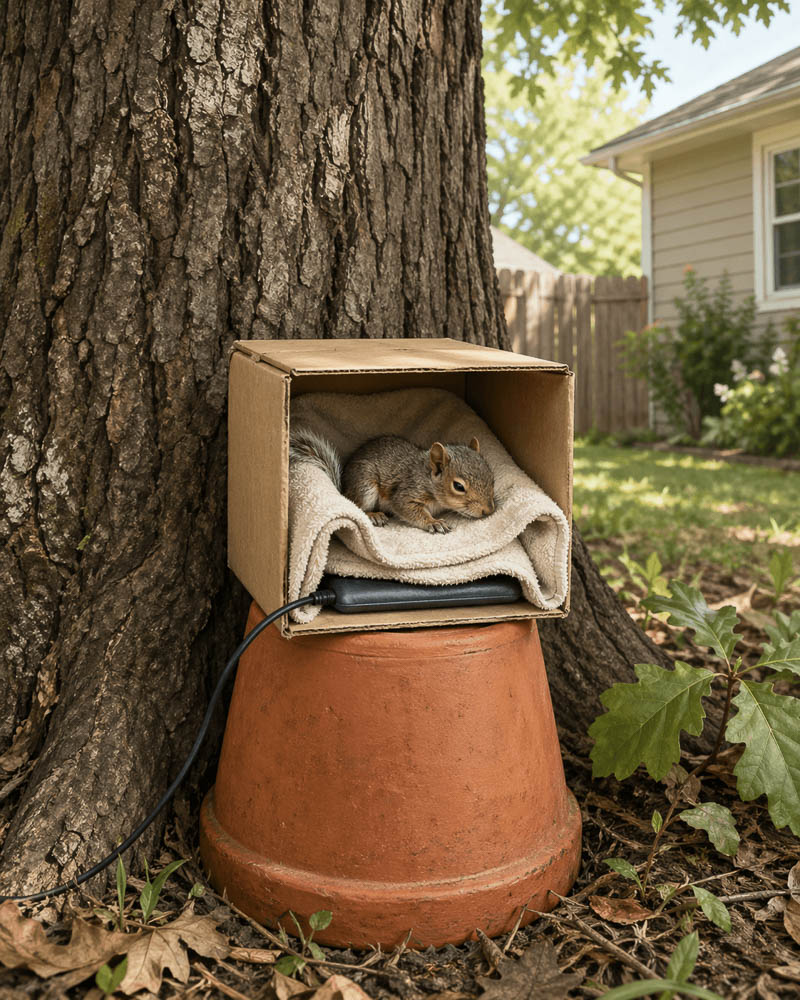
Once the baby is warm, place it at the base of the tree where you found it.
However, if the nest tree was cut down, use the closest tree available.
Keep the baby in its box or on a soft cloth. Then place the container up off the ground on a small platform such as an upside-down flower pot, stump, or similar surface. This helps protect the baby from predators.
At the same time, keep the setup out of direct sun.
Do not put a tight lid on the container. Instead, leave it open or very loose so mom can grab the baby easily.
Step 1d: Play Baby Squirrel Distress Calls
Next, play baby squirrel distress calls on your phone. Loud.
This is one of the most effective tricks in this entire guide, yet almost nobody knows it.
Pull up YouTube and search for baby squirrel distress call or baby squirrel crying. Then play it as loudly as your phone allows, pointing the speaker up toward the tree canopy.
The louder the better.
Mom squirrels can hear a crying baby from a surprising distance. In fact, the recorded calls often sound more urgent than the real thing, which is exactly what you want.
I have personally watched a mother squirrel come down her tree within minutes of starting the audio. One by one, she picked up each baby and carried them to a backup nest in the next tree over.
In practice, it works.
More importantly, it works so well that I recommend it over nearly any other technique.
Give mom time to return
Step 1e: Walk Away and Give Her Time
Walk away. All the way away.
Go inside and keep pets locked up. In addition, keep kids away from the window so the area stays quiet.
A squirrel mom will not approach if she can see humans watching. Because of that, distance matters more than people realize.
Give her at least 2 to 4 hours of complete quiet. However, if it is rainy or cold, allow even more time.
In most cases, a full daylight afternoon is not too long.
If mom has not come yet, it is perfectly fine to restart the distress audio once or twice during that waiting window.
Step 1f: Check Back Before Dark
Before dark, check the setup.
If the baby is gone, mom got it. Victory.
However, if the baby is still there at dusk, mom is not coming. At that point, bring the baby inside, keeping it warm and in the box.
Next, move to Step 4 for containment and contact.
Do not leave a baby squirrel outside overnight. Raccoons, owls, and cats all hunt at night, and darkness changes the risk completely.
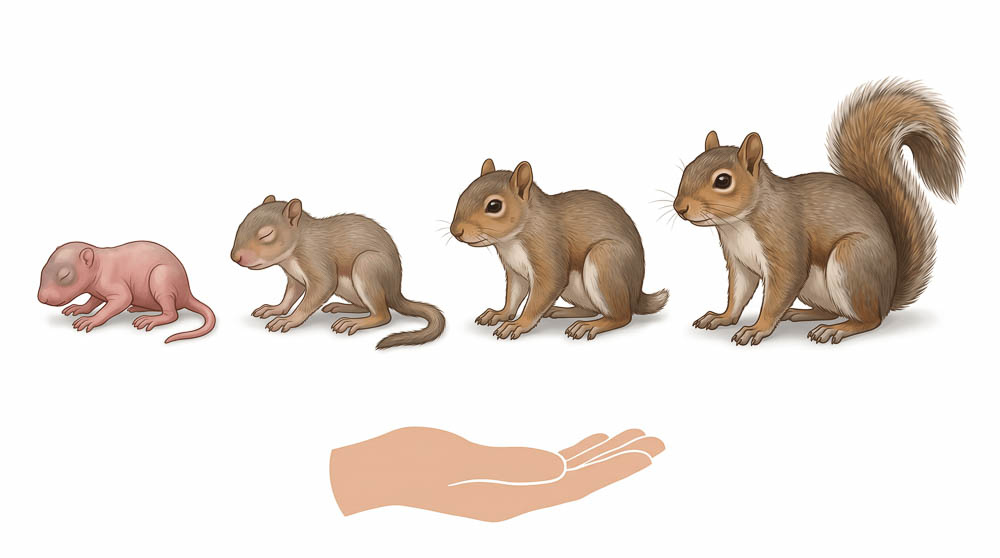
Step 2: Found a Baby Squirrel? How to Tell Its Age
When you have found a baby squirrel, age determines what happens next. Because of that, estimating age is one of the most useful skills you can have.
Below is the quick-reference field guide.
Newborn — Under Two Weeks Old
Pink, hairless, eyes closed, smaller than a walnut
At this stage, the baby is fully nest-dependent. Therefore, a re-nest attempt should always be your first move.
However, if mom does not return, this baby needs a rehabber within hours.
Do not try to raise it yourself. It will die.
Three to Four Weeks Old
Thin fur starting to come in, eyes still closed, about the size of a large strawberry
At this age, the baby is still fully dependent on mom.
For that reason, re-nesting should always be your first step.
Older juveniles behave differently
Five to Six Weeks Old
Fully furred, eyes open or just opening, tail starting to get fluffy, about the size of a small kiwi or lime
Eyes typically open around five weeks. Even so, the baby is still nest-dependent and still needs its mother.
Because of that, re-nesting remains the correct first move.
Seven to Ten Weeks Old
Fully furred, eyes wide open, bushy tail, climbs on you, body about the length of a dollar bill, chattering and bold
At this stage, the baby is getting close to independence—but not there yet.
Mom is still feeding this one. As a result, a re-nest attempt can still work at this age.
Ten to Twelve Weeks Old
Almost adult-sized body, full tail, running and climbing well, seems capable but follows you around
Body size is almost adult, tail is full, running, climbing, and seems perfectly capable but is following you around. This one is a social problem, not an orphan problem.
At 10 to 12 weeks, juvenile squirrels sometimes approach humans because they are curious and have not learned fear yet. If it is not injured, leave it alone and go inside. It will wander off and figure out life.
Step 3: Found a Baby Squirrel? Signs It Needs Help
Not every situation where you have found a baby squirrel is an emergency, but some absolutely are. Do not attempt re-nesting. Instead, move straight to containment and call a rehabber if any of the following are true:
For example, the baby may have visible blood, a wound, or a broken limb.
A cat or dog had it in their mouth, even if you see no obvious injury. Cat saliva is a death sentence for small mammals if not treated within hours. This is not an exaggeration.
There are flies buzzing around it, fly eggs (yellow-white grains stuck to fur, especially around the eyes, nose, mouth, and genitals), or visible maggots.
The baby is cold and limp, not just cool. Limp is the word that matters.
You found the dead mother nearby. Confirmed dead, not just absent.
The nest was destroyed and the tree was cut down, with no surviving tree nearby, hours ago.
The baby has been alone and cold for more than 6 to 8 hours with no sign of mom.
A bird of prey dropped it. Hawks and owls sometimes lose grip on prey.
However, if none of those apply, go back to Step 1.
In most situations, the re-nesting attempt is still the right first move.
Step 4: Found a Baby Squirrel? Containment the Right Way
If re-nesting failed, or you skipped it for a good reason, here is exactly what to do.
You will need:
A small cardboard box or pet carrier
A soft cotton t-shirt, fleece, or flannel
No terrycloth. No loose threads. No towels with loops that toes can get stuck in.
A heating pad set to LOW,
or a sock filled with uncooked rice and microwaved for 30 seconds,
or a bottle of warm (not hot) tap water wrapped in cloth
A quiet, dark, warm room away from pets and kids
Steps:
Put on gloves.
Squirrels, even tiny ones, can carry parasites and occasionally diseases. In addition, their teeth are sharper than they look once they have any teeth at all.
Gently lift the baby, supporting its whole body.
Do not squeeze.
Next, place the baby on the soft cloth in the box.
Position the heat source on one side of the box.
Put it under the cloth, not directly under the baby. Keep half the box warm and half at room temperature so the baby can crawl off the heat if needed.
Loosely cover the box with a towel.
This helps make the space dark and calm.
Move the box to the quietest room you have.
No TV. No music. No people coming in to peek. No kids. No pets in the room or even an adjacent room.
Do not feed it.
Do not give it water. Do not give it anything.
Call a rehabber.
Numbers are listed below.
Squirrels are more robust than cottontails. They do not generally die of stress the way bunnies do. But they can easily be killed by the wrong food, the wrong water technique, or the wrong temperature. “Do nothing” is the correct protocol until an expert takes over.
Step 5: Found a Baby Squirrel? What to NEVER Do
These mistakes kill more baby squirrels than any predator.
Because of that, avoiding these errors matters just as much as doing the right things.
Feeding mistakes that kill baby squirrels
Do not give cow’s milk, goat’s milk, kitten formula, puppy formula, human baby formula, Pedialyte, sugar water, or honey water.
Cow’s milk causes fatal diarrhea. Even correct species formulas, when given by an untrained person, often cause aspiration pneumonia. That means milk ends up in the lungs, which is usually fatal.
In reality, you cannot give a baby squirrel the right food.
A rehabber can.
Do not give nuts, seeds, fruit, bread, or anything solid.
A baby that cannot yet chew will choke. Meanwhile, a slightly older baby that can chew still cannot digest adult food properly. As a result, it will develop life-threatening diarrhea.
Do not give water with an eyedropper or syringe.
Babies aspirate liquid into their lungs extremely easily. Because of that, this is one of the most common causes of death in well-meaning rescues.
Also, do not bathe it.
Even if it looks dirty. Especially if it is cold.
A wet, cold baby dies fast.
Most importantly, do not keep it as a pet.
It is illegal in Kentucky and Indiana without a rehabilitation permit. In addition, it almost always ends badly for the squirrel.
Hand-raised squirrels that do not get proper release training usually face one of two outcomes. Either they become aggressive at sexual maturity and must be euthanized, or they are released and die quickly because they never learned to be squirrels.
Handling mistakes that create danger
Do not let your “very gentle” cat or dog see it.
Even through a crack in the door, exposure to pets creates serious risk. What looks like curiosity to you can quickly turn into injury for the baby.
Do not post on Facebook asking for advice.
You will get 200 answers, half of them wrong, and lose hours the baby does not have. Instead, call a rehabber right away and get verified instructions.
Time matters more than opinions.
Do not drive around with it for hours looking for help.
If you cannot reach a rehabber immediately, follow the containment protocol and wait. In most cases, keeping the baby warm and quiet is far safer than constant movement.
Do not microwave it, oven-warm it, or use a hairdryer.
People do this. Please do not do this.
Rapid heat changes can kill a baby squirrel faster than cold exposure.
Step 6: Found a Baby Squirrel? Find a Licensed Wildlife Rehabber
If re-nesting fails or injury is present, then contact a licensed wildlife rehabber as soon as possible.
Even if the first number cannot help, keep calling. Capacity changes daily, especially during baby season.
Louisville and Jefferson County
Ruffled Feathers Parrot Sanctuary (RFPS)
Phone: 502-235-7493
Hours: 8am–04pm
Notes: We can advise by phone, coordinate transport, and route to the nearest rehabber with available capacity.
Other Louisville-Area Rehabbers
ope and Promise Wildlife Rehab – 502-417-8849 — Raccoons
Raptor Rehabilitation of Kentucky, Inc. – 502-491-1939 — Raptors
Shively Animal Clinic & Hospital, P.S.C. – 502-778-8317 — Mammals, Reptiles, Amphibians
Broadbent Wildlife Sanctuary – 270-547-4200 — Mammals, Reptiles, Amphibians, Raptors, Songbirds
Second Chances Wildlife Center – 502-888-5470 — Mammals
Feathers Galore (Parrot Rescue) – 502-833-6778 — Parrots
Across Kentucky — Mammal Rehabbers
Grit & Grace Wildlife Rehab — Bourbon County — 859-954-0788
Country Critters Wildlife Rescue, Inc. — Boyle County — 859-583-7035
Critter Ridge Sanctuary — Franklin County — 502-750-0773
A Stable Place Wildlife — Logan County — 270-893-6397
West KY Wildlife — Muhlenberg County — 270-543-1345
Mountain View Wildlife Rehabilitation — Perry County — 606-854-1622
Born 2 Be Wild Wildlife Center — Pulaski County — 606-383-1936
Across Kentucky — Raptors and Birds
Kathy Caminiti — Boone County — 859-466-8873
Back Too the Wild Rescue/Rehab — Christian County — 810-434-0067
Wolf Run — Jessamine County — 859-227-8650
Across Kentucky — Specialty Rehabbers
Fat Bottomed Squirrels — Daviess County — 270-570-0194
KY Squirrel Rehab — Scott County — 502-542-0043
Dawn Stemle — Spencer County — 502-902-0169
Statewide Resources
Kentucky Department of Fish and Wildlife official rehabber roster:
fw.ky.gov rehabber search
(Searchable by county and species)
Southern Indiana & National Resources
Indiana DNR permitted rehabber list: in.gov rehabber directory (searchable by county) Shortcut: bit.ly/INwildliferehablist
Utopia Wildlife Rehabilitators (Hope, IN, central but takes from southern counties): 812-546-6318, [email protected]
Wesselman Woods (Evansville area, referral assistance): wesselmanwoods.org/wildliferehab
Anywhere in the country
Animal Help Now (ahnow.org or AHNow app): real-time location-based search for the closest licensed rehabber. Best single resource for out-of-area readers and for evenings or weekends when the state directories are harder to navigate.
A note on capacity
Spring is hard on rehabbers. Every facility in our region fills up within weeks of the first warm spell, and most of us are running with limited volunteers, limited space, and zero government funding.
If the first three numbers you call cannot take the animal, please keep going. Do not assume nobody will help.
The fourth or fifth call is often the one that connects.
Step 7: Found a Baby Squirrel? What to Do While Waiting for Transport
Keep the box covered, warm, and quiet.
Meanwhile, drive at normal speeds. No music. No loud phone calls.
Do not check on the baby every five minutes. The less interaction, the better.
If transport is more than two hours, call ahead and ask whether the rehabber wants you to attempt anything in the meantime. Default answer is no.
“I already had it for a day and was feeding it cow’s milk”
You are not in trouble. We get this call every spring. Here is the honest situation:
Stop feeding it immediately. Whatever you have been giving it, stop. Do not try to “wean” it off. Just stop.
Tell the rehabber exactly what you gave it and how much. Do not minimize. They need to know to manage gut complications.
Bring it in today. Not tomorrow.
If it has been more than a few days and the baby seems okay, that is encouraging, but it is not out of the woods.
Aspiration pneumonia and nutritional deficiencies often do not show up until day 4 or 5.
The earlier we get them, the better the odds.
But “I messed up for a day” is not a reason to give up.
Call.
Why Found Baby Squirrels Are Tricky in Rehab
Squirrels are generally more survivable in rehabilitation than cottontails. They eat aggressively, they are tough, and they bounce back from a lot.
The hard part is not keeping them alive. The hard part is releasing them as actual wild squirrels.
A squirrel that imprints on humans is a squirrel that will climb onto strangers at the park, get chased by dogs it should have run from, and bite people expecting food.
That is a euthanasia case, not a rehabilitation success.
Licensed rehabbers raise squirrels in groups. They minimize human contact starting at eye-open and release them into pre-release enclosures so they learn to climb, find food, and recognize predators before they are fully free.
A person raising one in their kitchen cannot replicate any of that.
This is why we are so insistent on “call a rehabber, do not try to keep it.”
A squirrel mom is plan A.
Licensed rehab is plan B.
There is no plan C that ends well.
Preventing the Next Time You Find a Baby Squirrel
Most of the baby squirrels that come into rehab every year could have been prevented.
Often, it only takes one small action.
Do not trim trees between February and October unless absolutely necessary. Squirrels have two baby seasons, roughly February to April and July to September, and active nests are often invisible from the ground.
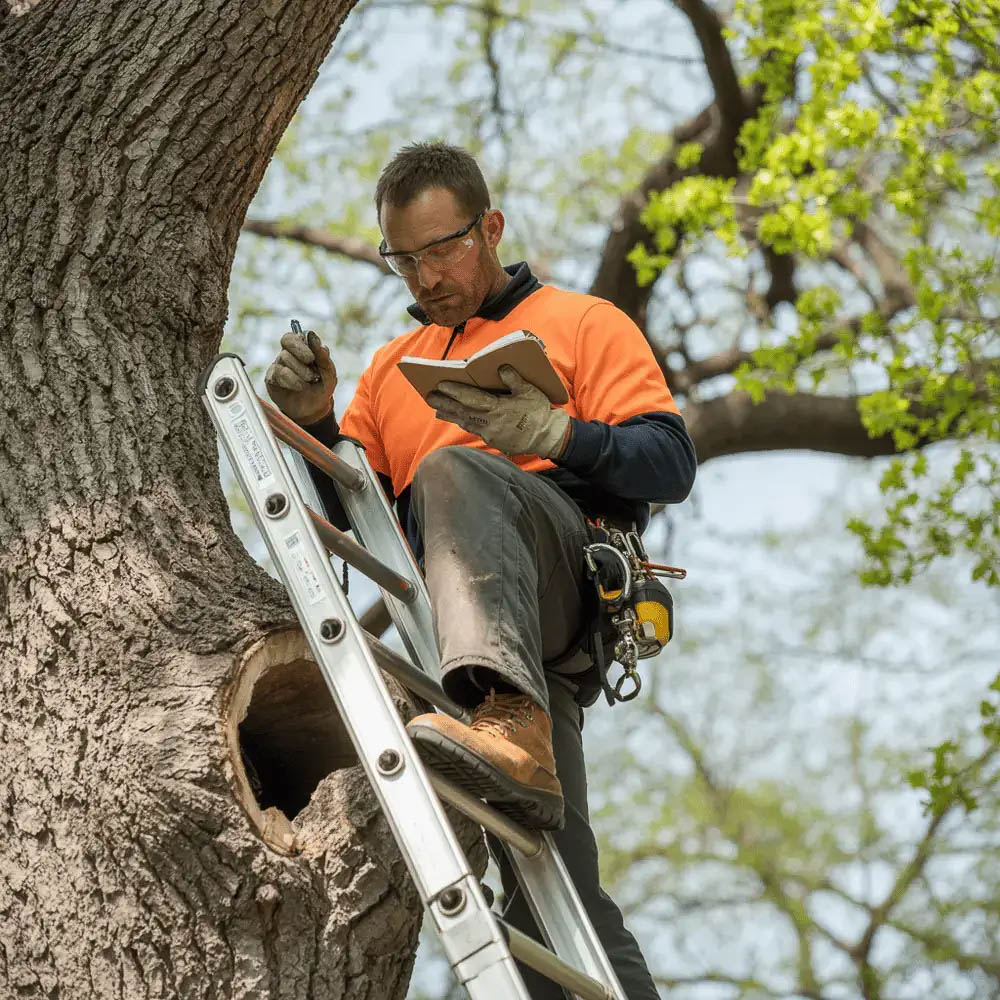
If tree work is unavoidable in those windows, hire an arborist who checks for nests before cutting. Reputable tree services will do this without being asked.
Cap your chimney. Every spring we get calls from people who suddenly have chittering coming from their fireplace. Squirrels love chimneys. Chimney caps are cheap, a one-time install, and they also keep out raccoons, bats, and birds.
Keep cats indoors. Number one predator of baby squirrels that have just left the nest. We are not moralizing, we are just telling you what we see. The calls are constant.
Leash dogs during spring and late summer. A dog that is otherwise perfectly well-behaved will kill a baby squirrel in under five seconds out of pure curiosity.
Before starting, check brush piles or burn piles carefully. Squirrels nest in them.
If you see a nest get knocked down by wind or storm, do the re-nesting protocol immediately. Mom is often still nearby and the window to reunite is small.
A note from RFPS
We have helped over 20,000 animals since 2015. Spring storm season and late summer tree work are the twin peaks of baby squirrel calls.
A good 60 to 70 percent of them end with the baby going back to mom, which is exactly the outcome we want. But that only happens when people call before they act.
Every spring we also get calls from folks who fed their baby squirrel for a week before realizing something was wrong. Sadly, those cases break our hearts because they could have gone differently.
Finally, share this guide
If you know someone with trees, a yard, a chimney, or a chainsaw, send them this link before the next storm. Prevention scales. One share might save a whole litter.
Up next in the series
Coming next: Baby raccoons
Browse the full Found a Baby series →
Ruffled Feathers Parrot Sanctuary Inc. is a 501(c)(3) wildlife rescue based in Louisville, Kentucky. We rely entirely on community donations. If this guide helped you, please consider making a donation so we can keep the lights on for the next call.
Some of our related content:

Where Hope Takes Flight