Ruffled Feathers Parrot Sanctuary Inc.
Where Hope Takes Flight


I Found a Baby Bunny. Now What?
A complete, no-panic guide to baby cottontails in Kentucky and southern Indiana
Part 1 of the Ruffled Feathers Parrot Sanctuary “Found a Baby” series.
Read this part before you do anything else
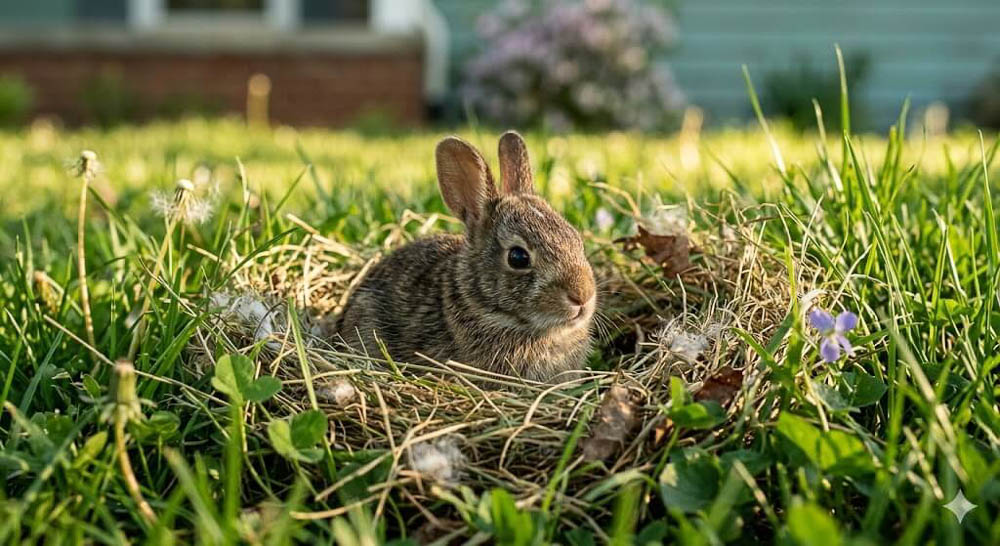
Most baby bunnies people “rescue” did not need rescuing. That sounds harsh, and we know your heart is in the right place, but it is the single most important thing we can tell you.
Cottontail moms intentionally stay away from the nest almost all day so predators do not follow her scent to the babies. She comes back to nurse twice in 24 hours, usually once around dawn and once around dusk, for about five minutes each time. That is it.
The rest of the day the nest looks completely abandoned. It is not. A healthy nest of bunnies sitting quietly in your yard with nobody around is exactly what a healthy nest of bunnies is supposed to look like.
A healthy nest of bunnies sitting quietly in your yard with nobody around is exactly what a healthy nest of bunnies is supposed to look like.
So, before you scoop, take a breath, and walk through the steps below. If they really are orphaned or hurt, we will get them help. If they are not, the kindest thing you can do is leave them alone.
Step 1: First, figure out how old the bunny is
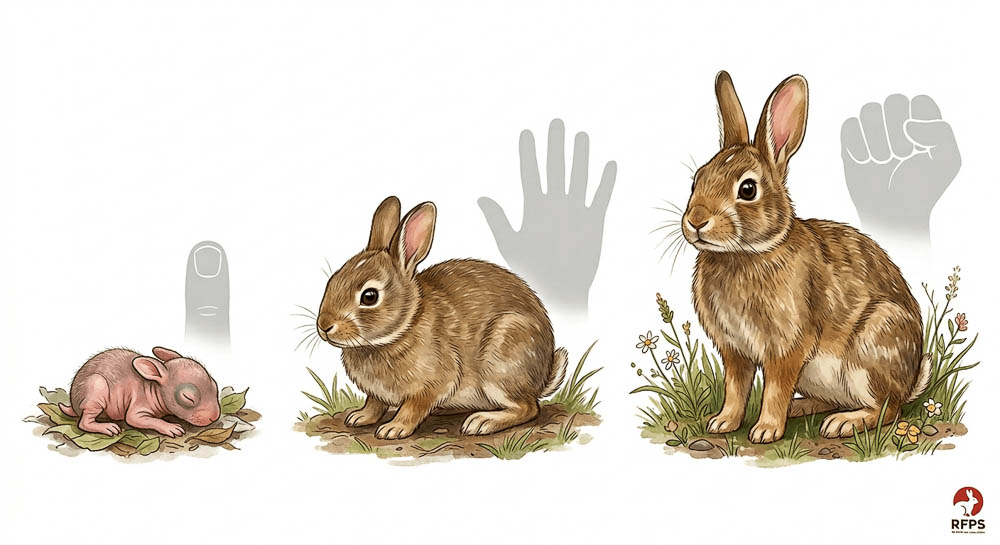
Cottontails grow up fast. The age tells you almost everything.
Eyes closed, no fur or thin fur, ears flat against head, smaller than your palm. This is a true infant, under about ten days old. It belongs in the nest. If you can find the nest, put it back.
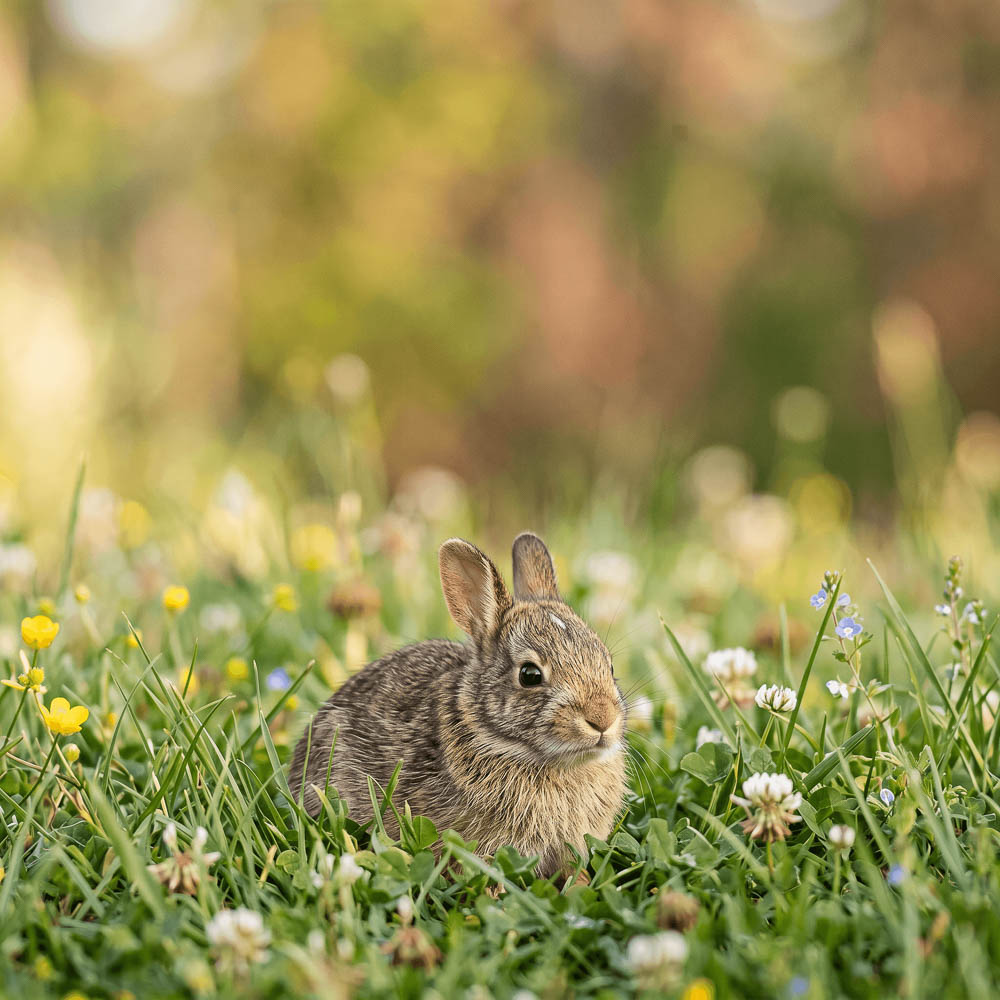
Eyes open, fully furred, ears starting to stand up, about the size of a tennis ball. This bunny is around two to three weeks old. Still nest-dependent. If you found it wandering far from a nest, something disturbed the nest and it needs help locating it again.
Eyes open, fully furred, about the size of a softball or a little bigger, four inches long or more, can hop and run.
This bunny does not need you. Cottontails are weaned and on their own at three to four weeks old. They are tiny. They look like they should still be with mom. They are not. If it can run from you, it is independent. Walk away. We mean that with love. Walk away.
Step 2: Next, use the string test (this is the one that matters)
If the babies are nest-aged but you are not sure mom is still alive and visiting, here is how to find out without disturbing them.
Go to the nest. Lay a few pieces of light-colored yarn, dental floss, or thin twigs across the top of the nest in a tic-tac-toe pattern. Take a photo from directly above so you remember exactly how it looked.
Walk away. Then keep pets and kids away from the area. Do not check it for at least 12 hours, ideally 24.
If the pattern is disturbed, the nest is warm, and the babies look round and pink-bellied, mom is coming back. Leave them alone. They are doing fine.
However, if the pattern is undisturbed after a full 24 hours, the babies are cold to the touch, their bellies look sunken, or they are crying loudly and continuously, mom is gone. Move to Step 3.

Step 3: If needed, step in immediately
However, skip the string test and intervene immediately if any of these are true:
A cat or dog had it in their mouth, even if you see no obvious injury. Cat saliva is a death sentence for small mammals if not treated within hours. We are not exaggerating.
You can see blood, a wound, or a broken limb.
There are flies, fly eggs (small yellow-white grains stuck to fur, especially around eyes, nose, ears, genitals), or maggots present.
The bunny is cold and limp, or feels cool to the touch even on a warm day.
You found the dead mother nearby. Confirmed dead, not just absent.
The nest was destroyed by mowing, landscaping, or construction and cannot be reconstructed.
The bunny has been alone, in the open, with no nest in sight, for more than 24 hours.
If none of these apply, go back to Step 2. Most of the time the answer is the string test.
Step 4: Then contain the bunny the right way
If the bunny needs help, then here is exactly what to do in the next ten minutes.
You will need:
A small cardboard box (shoebox is perfect)
A soft cotton t-shirt or fleece, no terrycloth and no loose threads
A heating pad set to LOW, or a sock filled with uncooked rice and microwaved 30 seconds, or a bottle of warm (not hot) tap water wrapped in cloth
A quiet, dark room
Steps:
First, put on gloves or use a clean towel. Cottontails carry parasites and can also be carriers of tularemia, which is rare but serious.
Gently lift the bunny. Support its whole body. Do not squeeze.
Next, place it on the soft cloth in the box.
Put the heat source on one side of the box, under the cloth, not directly under the bunny. The bunny needs to be able to crawl off the heat if it gets too warm. Half the box warm, half the box room temperature.
Finally, cover the box loosely with a towel.
Put the box in the quietest room you have. No TV. No music. No people coming in to peek. No kids. No pets in the room or any adjacent room.
Do not feed it. Instead, do not give it water. Do not give it anything. This is the part everyone gets wrong.
Call a rehabber. Numbers are below.
That is it. That is the whole protocol until a rehabber takes it. Stress kills cottontails faster than almost any injury. Every additional minute of human contact, light, sound, and handling brings them closer to death. We know this is hard. The kindest thing you can do is sit it in a dark closet and walk away.
Step 5: Most importantly, what to NEVER do
These mistakes kill more cottontails than any predator. Read this section twice.
Never give cow’s milk, goat’s milk, kitten formula, puppy formula, Pedialyte, sugar water, or honey water. Cow’s milk will give a bunny fatal diarrhea within hours.
Also, avoid giving lettuce, carrots, fruit, or anything else. Their gut bacteria are not developed enough, and you can rupture their stomach.
Bathing is not safe, even if the bunny looks dirty.
Never warm it up in an oven, microwave, or with a hairdryer. Yes, people do this. Please do not do this.
Handling should be kept to an absolute minimum. Show it to your kids tomorrow in photos, not in person.
Pets must never be allowed to meet the bunny, even if they are “very gentle.”
Do not post on Facebook asking for advice. You will get 200 contradictory answers and waste hours the bunny does not have. Call a rehabber.
Do not try to keep it. Even if you wanted to and even if it was legal (it is not), cottontails almost never survive being raised as pets. They are panic-bred for a reason.
Do not drive it around in the car for hours. If you cannot reach a rehabber immediately, follow the containment protocol above and wait.
Instead of posting on Facebook asking for advice, call a rehabber immediately. You will get faster, safer help.
Step 6: Finally, here is who to call
Louisville and Jefferson County
Ruffled Feathers Parrot Sanctuary (RFPS) Phone: 502-235-7493] Hours: 8am-04pm Notes: We can advise by phone, coordinate transport, and route to the nearest rehabber with capacity.
Other Louisville-area rehabbers: 1. Hope and Promise Wildlife Rehab –
502-417-8849 – Raccoons 2. Raptor Rehabilitation of Kentucky, Inc. –
502-491-1939 – Raptors 3. Shively Animal Clinic & Hospital, P.S.C. – 502-778-8317 – Mammals, Reptiles, Amphibians 4. Broadbent Wildlife Sanctuary – 270-547-4200 – Mammals, Reptiles, Amphibians, Raptors, Songbirds 5. Second Chances Wildlife Center – 502-888-5470 – Mammals
Across Kentucky – Mammal Rehabbers
Grit & Grace Wildlife Rehab – Bourbon County – 859-954-0788
Country Critters Wildlife Rescue, Inc. – Boyle County – 859-583-7035
Critter Ridge Sanctuary – Franklin County – 502-750-0773
A Stable Place Wildlife – Logan County – 270-893-6397
West KY Wildlife – Muhlenberg County – 270-543-1345
Mountain View Wildlife Rehabilitation – Perry County – 606-854-1622
Born 2 Be Wild Wildlife Center – Pulaski County – 606-383-1936
Across Kentucky – Raptors and Birds
Kathy Caminiti – Boone County – 859-466-8873
Back Too the Wild Rescue/Rehab – Christian County – 810-434-0067
Wolf Run – Jessamine County – 859-227-8650
Across Kentucky – Specialty Rehabbers
FAT BOTTOMED SQUIRRELS – Daviess County – 270-570-0194
KY Squirrel Rehab – Scott County – 502-542-0043
Dawn Stemle – Spencer County – 502-902-0169
Statewide Resources
Kentucky Department of Fish and Wildlife official rehabber roster: fw.ky.gov rehabber search (searchable by county and by species)
Kentucky Wildlife Center (Georgetown area, statewide referrals): [email protected]
Southern Indiana
Southern Indiana & National Resources
Indiana DNR permitted rehabber list: in.gov rehabber directory (searchable by county) Shortcut: bit.ly/INwildliferehablist
Utopia Wildlife Rehabilitators (Hope, IN, central but takes from southern counties): 812-546-6318, [email protected]
Wesselman Woods (Evansville area, referral assistance): wesselmanwoods.org/wildliferehab
Anywhere in the country
Animal Help Now (ahnow.org or AHNow app): real-time location-based search for the closest licensed rehabber. Best single resource for out-of-area readers and for evenings or weekends when the state directories are harder to navigate.
A note on capacity
Spring is hard on rehabbers. Every facility in our region fills up within weeks of the first warm spell, and most of us are running with limited volunteers, limited space, and zero government funding. If the first three numbers you call cannot take the animal, please keep going. Do not assume nobody will help. The fourth or fifth call is often the one that connects.
Step 7: While you wait for transport
Most rehabbers cannot drop everything to come to you. You will likely need to transport. Here is how to do it without making things worse.
Keep the box covered, warm, and quiet.
Drive at normal speeds. No music. No phone calls.
Do not check on the bunny every five minutes. Resist the urge.
If transport is more than two hours, call ahead and ask whether the rehabber wants you to attempt anything in the meantime. Default answer is no.
“I already had it for a day before I found this article”
You are not in trouble. We get these calls every spring and we never judge. Here is the honest situation:
If you fed it cow’s milk, formula, or anything else, tell the rehabber exactly what and how much. Do not minimize. They need to know to manage gut complications.
If you handled it a lot, that is okay. Get it into the dark quiet box now and call.
If it has been more than 48 hours and the bunny still seems lively, that is encouraging but not a guarantee. Cottontails can crash suddenly from delayed stress.
Get help today. Not tomorrow. Today.
The earlier we get them, the better the odds. But “I waited two days” is not a reason to give up. Call.
Why cottontails are so hard
Most people do not realize that even licensed wildlife rehabbers consider cottontails one of the most challenging species we work with.
The mortality rate in rehab is high even when everything is done right. Their digestive systems are extraordinarily delicate.
They are prey animals to their bones, which means stress alone can kill them.
Captive-raised cottontails often have to be released slightly older than wild kits to give them a fighting chance.
This is why we are so insistent that you confirm the bunny actually needs help before intervening.
A wild-raised, mom-fed cottontail has dramatically better odds than the same bunny in the best rehab facility in the country. Mom is always plan A. We are plan B.
Preventing the next one
If you are reading this in spring, you can save lives without ever picking up a bunny. A few minutes of prevention is worth more than any rescue.
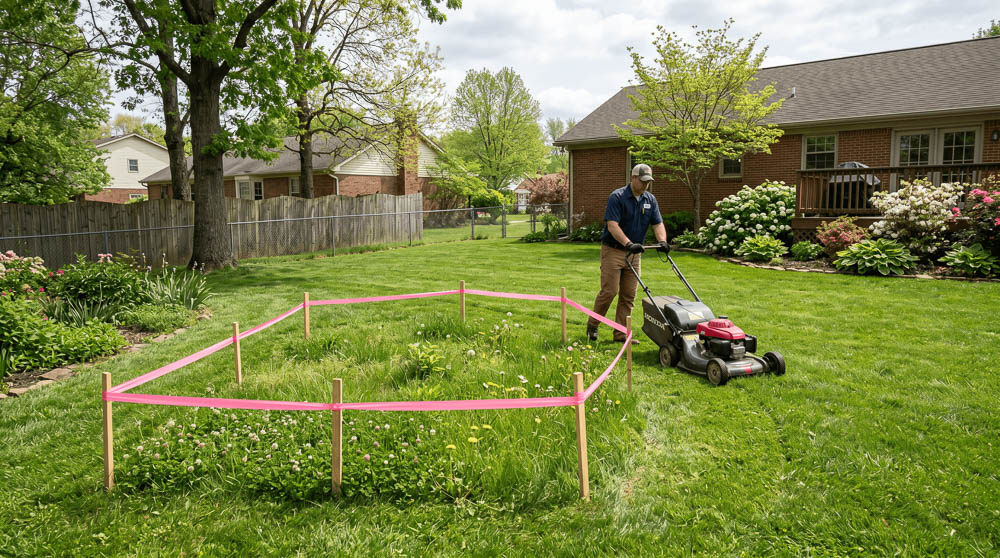
Most importantly, walk your yard before you mow. Every single time, March through September. Cottontail nests are shallow depressions in the grass, often right out in the open lawn, covered with a thin layer of dried grass and fur. They look like nothing. They are very easy to mow over. If you find one, mark a six-foot radius with stakes or chairs and skip that patch for two to three weeks. The babies will be gone by then.
Keep cats indoors. This is the single biggest thing you can do for backyard wildlife. We are saying this kindly. We love cats. Cats kill an estimated 2.4 billion birds and 12 billion mammals in the US every year. The number one source of “found bunny” calls we get is cat-caught.
Leash dogs in spring. Even friendly dogs will kill a nest of bunnies in 30 seconds out of pure curiosity.
Wait on landscaping. Push major yard work to late summer if you can.
Talk to your neighbors. One nest, one mowing, one minute of awareness. That is the chain.
A note from RFPS
We have helped over 20,000 animals since 2015. Every single spring, the cottontail calls start in late March and do not slow down until July.
The hardest calls are not the ones where someone found a hurt bunny.
The hardest calls are the ones where someone found a perfectly healthy bunny, took it home, fed it cow’s milk for three days, and is now calling us to ask why it died.
We are not telling you any of this to make you feel bad.
We are telling you because the next bunny you find might be the one we save together.
If you have any doubt, call before you act.
We would rather take a hundred phone calls about bunnies that did not need help than receive one bunny that we cannot save because the wrong thing was done in the first 48 hours.
Thank you for caring enough to find this page.
Share this guide
If you know someone with a yard, kids, dogs, or a lawn mower, send them this link before the next call. Prevention scales. One share might save a whole nest.
Video series
Up next in the series
Coming next: I Found a Baby Squirrel. Storm season just hit and we are getting calls daily. Bookmark this page or follow @ruffledfeathers on Facebook for the next installment.
Browse the full Found a Baby series →
Ruffled Feathers Parrot Sanctuary Inc. is a 501(c)(3) wildlife rescue based in Louisville, Kentucky. We rely entirely on community donations. If this guide helped you, please consider making a donation so we can keep the lights on for the next call.

Where Hope Takes Flight