Ruffled Feathers Parrot Sanctuary Inc.
Where Hope Takes Flight


A complete, no-panic guide to baby raccoons in Kentucky and southern Indiana
Part 3 of the Ruffled Feathers Parrot Sanctuary “Found a Baby” series.
Read this part first. This is important.
This baby raccoon rescue guide is designed to walk you through the right decisions step by step, because what you do in the first few minutes can make all the difference.
Baby raccoon rescue guide: If you’ve found a baby raccoon and aren’t sure what to do, this guide will walk you through exactly how to help safely. Raccoons are not like bunnies or squirrels. They are intelligent, resilient, and absolutely worth saving, but they come with important risks and legal considerations you need to understand first.
Watch this quick breakdown of our baby raccoon rescue guide before diving into the full step-by-step instructions below.
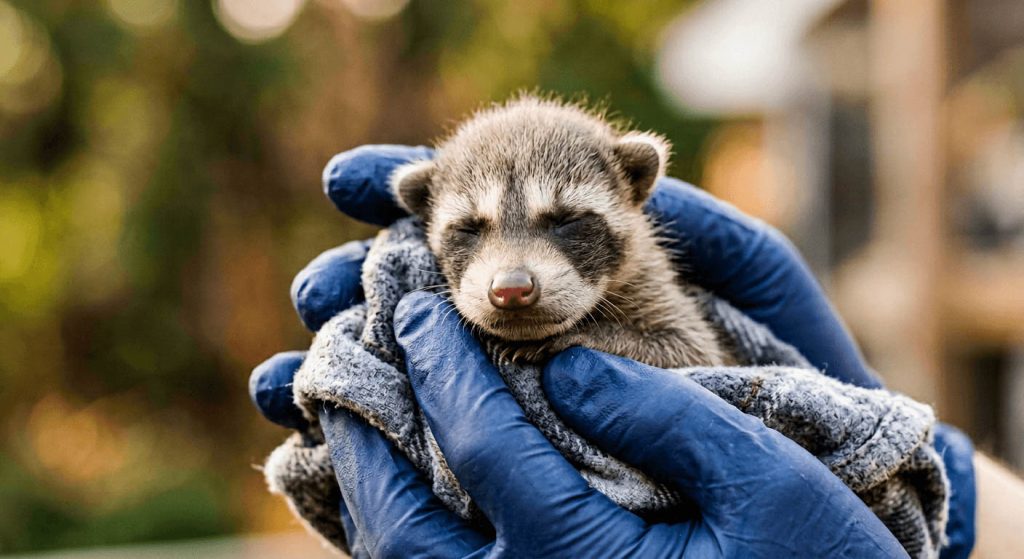
You should not handle a baby raccoon with bare hands. Ever. Even tiny pink eyes-closed newborns. Wear gloves. We will explain why below, but this rule does not bend.
If a raccoon (any age, any size) bites or scratches you, your child, or your pet, that animal will likely have to be euthanized and tested for rabies by the state. This is not RFPS policy. This is Kentucky and Indiana law. We have no power to override it. Once skin is broken, public health gets involved and the outcome is set.
Most wildlife rehabbers cannot legally accept raccoons. Rabies vector species require a special permit on top of a standard rehab license. This shrinks the contact list dramatically. You may have to drive farther than you would for a squirrel or a bunny.
We are starting with this because we love raccoons and we want yours to live. The single biggest threat to a baby raccoon’s survival is a well-meaning person who handled it bare-handed, got nipped, and now has to surrender it for mandatory testing. Please put on gloves before you even take a closer look.
That said, this is not a scary situation. It is a manageable one. Read the rest of this guide, take it slow, and you and the baby will both be fine.
This baby raccoon rescue guide starts with the most important rules first, because the wrong move in the first few minutes can change the outcome completely.
Baby Raccoon Rescue Guide: Reuniting With Mom
This is still the best outcome for a baby raccoon, and it works more often than people think.
Raccoon moms move their kits between dens regularly. A baby on the ground at the base of a tree, in a window well, in a chimney, or near a den site is often a baby that fell during a move, or got left behind temporarily. Mom is almost certainly nearby and will come back, usually after dark.
Here is exactly how to give her the chance.
Baby raccoon reunion steps
Step 1a: Confirm the baby is uninjured. With gloves on, take a careful look. If you see blood, visible wounds, broken limbs, fly eggs (yellow-white grains stuck to fur), maggots, cold-stiffness, or limpness, skip to Step 3 and go straight to containment and contact. Do not attempt reunion with an injured baby.
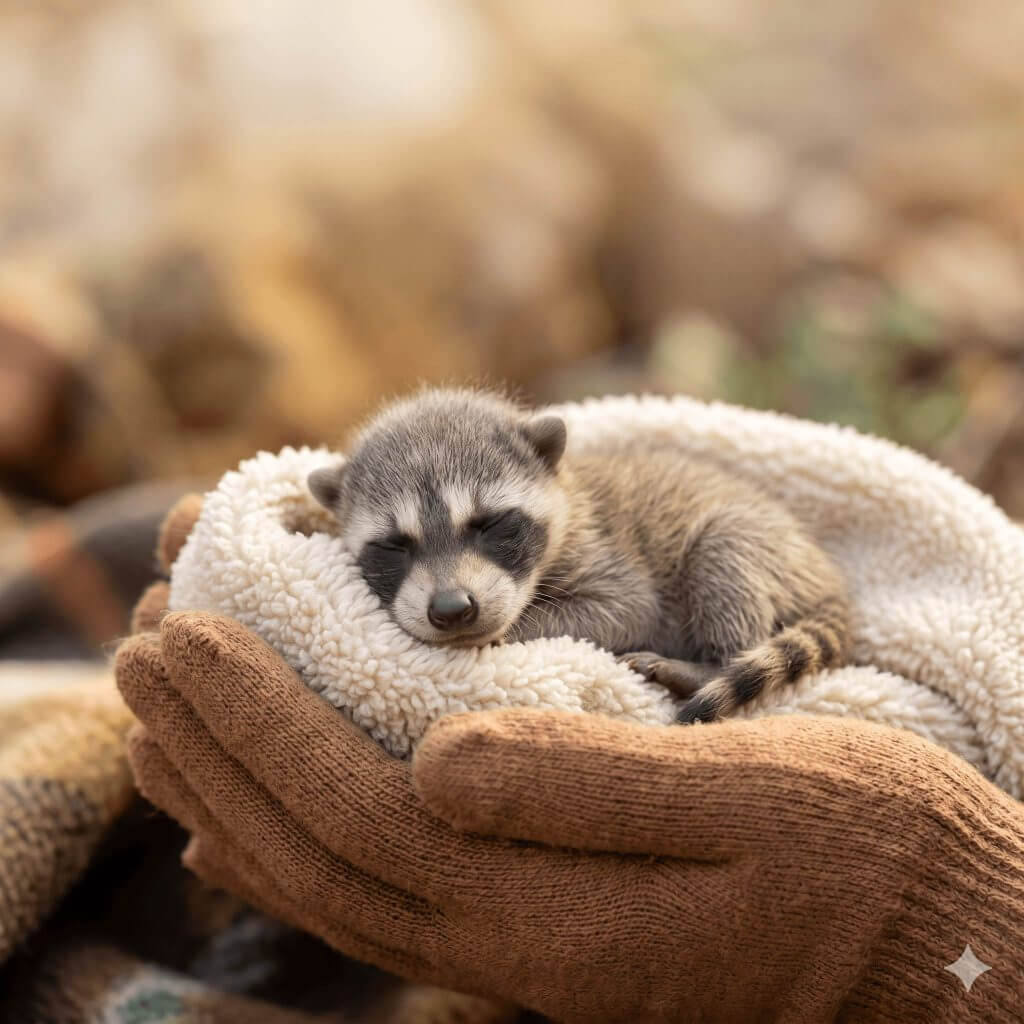
Step 1b: Warm the baby up first. A cold baby will not cry loudly enough for mom to hear. Use gloves, place the baby in a small cardboard box on a soft cloth, and put a heat source (low heating pad under the cloth, or a sock filled with uncooked rice microwaved 30 seconds, or a warm-not-hot water bottle wrapped in cloth) on one side of the box only. Half the box warm, half room temperature. Give it 30 minutes to warm up.
Warming a baby raccoon before reunion
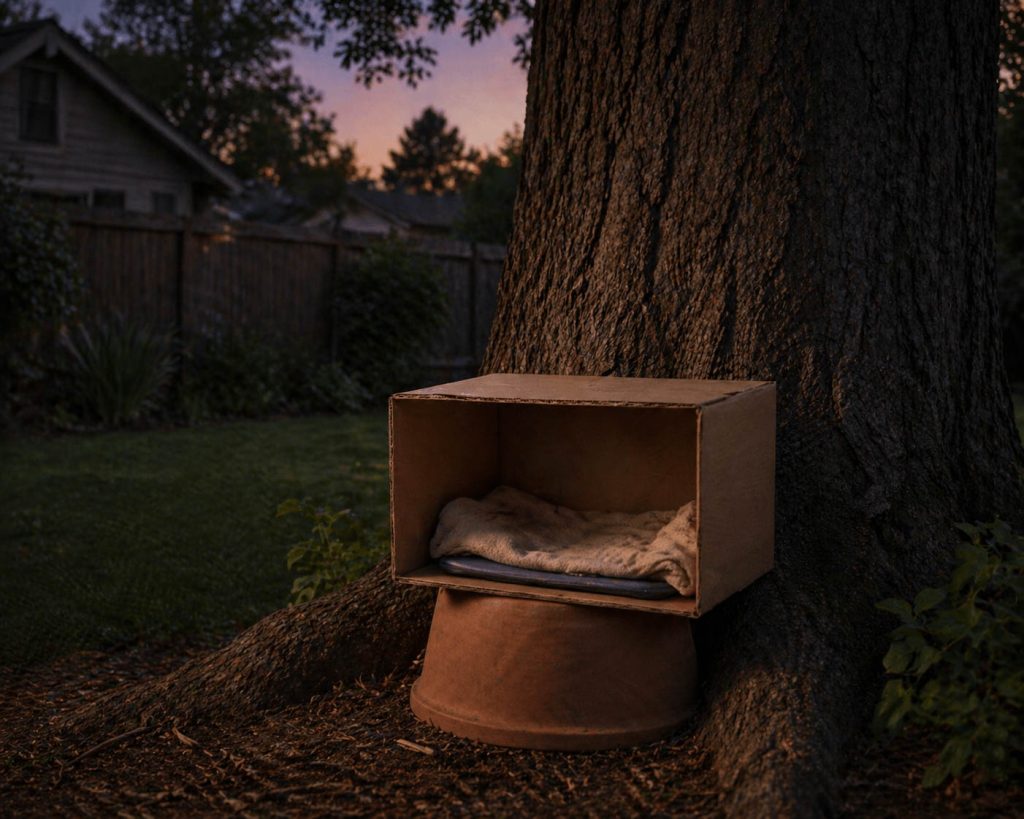
Step 1c: Place the box near where you found the baby, off the ground, before dark. Raccoons are nocturnal. Mom will not come for the baby in broad daylight. The right move is to place the warmed baby (still in the box, lid off or very loose) at the base of the tree or near the den site close to dusk, ideally in a spot that is sheltered from rain and out of direct view of pets, traffic, or porch lights. Elevate the box on an upside-down flower pot, stump, or low platform so ground predators (cats, dogs, stray foxes) cannot reach it easily.
Step 1d: Walk away. Inside. Lights off on that side of the house. Raccoon moms are cautious. She will not approach if she sees, hears, or smells humans nearby. Pets indoors. Outside lights off if they shine on the area. Give her the entire night.
When a raccoon mother will return
Step 1e: Check at first light, not before. If the baby is gone, mom got it. That is the win we want.
If the baby is still in the box at sunrise, mom is not coming. Bring the box inside (still warm), and move to Step 4 for full containment and contact. Do not leave a baby raccoon outside through a second day. Hawks, owls, dogs, and stray cats will find it.
One night is the rule. If mom is going to come, she will come the first night. Two-night attempts almost never improve outcomes and dramatically increase the risk of the baby getting cold, dehydrated, or predated.
In any baby raccoon rescue guide, reunion is always the best possible outcome when the baby is uninjured. It is also the step most people skip too quickly.
Baby Raccoon Rescue Guide: Determining Age
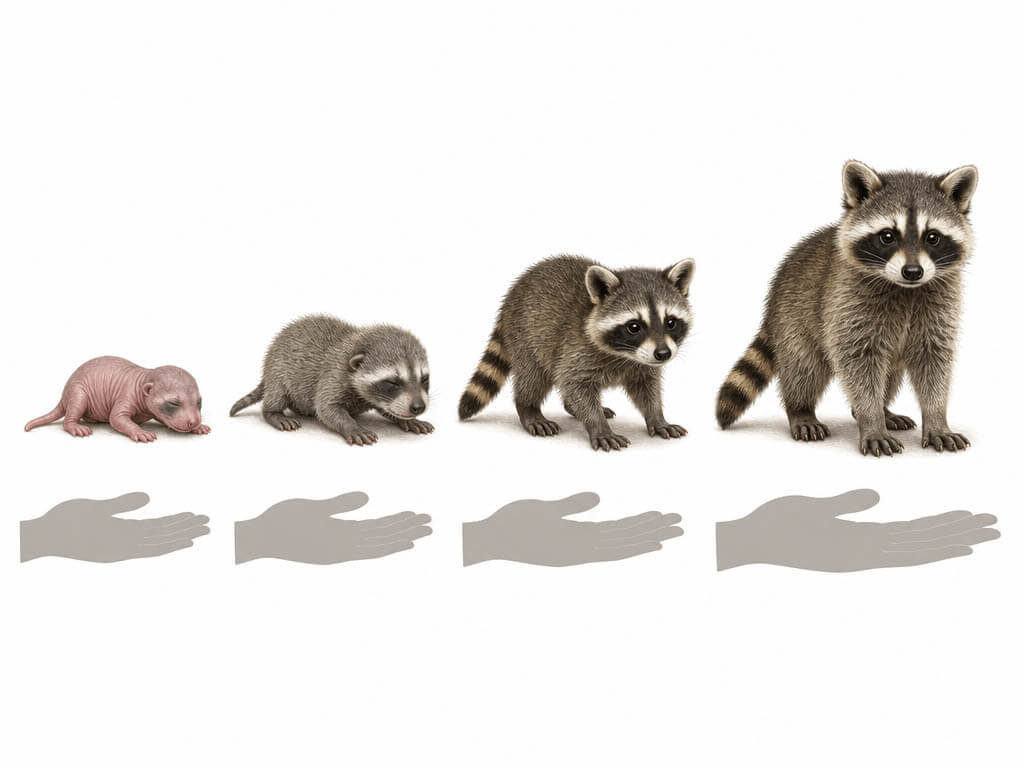
How to help a baby raccoon based on age
Raccoon age changes the urgency dramatically. Here is the field guide. How to help a baby raccoon based on age
Pink, hairless or barely-fuzzed, eyes closed, body about the size of a hamster. Newborn to two weeks old. Fully helpless. Mom has to be the one feeding it, period. If reunion fails, this baby needs a rehabber within 12 hours.
Newborn baby raccoon care basics
Gray fuzz coming in, faint mask starting to show, eyes still closed, about the size of a kitten. Around three to five weeks. Still completely dependent. Reunion attempt first. Eyes typically open between four and six weeks.
Fully furred with a clear black mask and ringed tail, eyes wide open, about the size of a small house cat, walking but wobbly. Around seven to nine weeks. Still nursing and den-bound. Reunion still works at this age.
How baby raccoon age affects survival
Full mask, full ringed tail, climbing well, about the size of a medium house cat, exploring on its own but still in family group. Around 10 to 16 weeks. This kit is starting to range with mom and siblings but is not yet independent. If you see one alone in daylight that looks healthy and is moving normally, walk away and check back in a few hours. Mom and siblings are likely close.
Signs of illness in baby raccoons
Full-sized juvenile, alone, daytime, looks “tame” or unafraid of you, possibly circling, drooling, head-tilted, or stumbling. This is not an orphan. This is a possible distemper or rabies case. Do not approach. Do not let pets approach. Call animal control or a wildlife agency. We will say more about this in the next section.
Knowing the age is a critical part of any baby raccoon rescue guide, because it determines how urgent the situation really is.
Baby Raccoon Rescue Guide: When to Intervene
Signs a baby raccoon needs help
Skip Step 1 and go straight to gloves-on containment and a phone call if any of these are true.
The baby has visible blood, a wound, or a broken limb. Signs a baby raccoon needs help
A cat or dog had it in their mouth, even briefly. Cat saliva is fatal to small mammals within hours. Dog bites cause crushing injuries even when teeth do not break skin.
Flies are buzzing around it, you see fly eggs (yellow-white grains in fur, especially around eyes, nose, mouth, ears, genitals, or any wound), or there are visible maggots.
The baby is cold and limp.
You found the dead mother nearby, confirmed dead, not just absent. (Common: roadkill mom, baby found wandering in the road’s shoulder.)
The den was destroyed by tree work, demolition, or chimney/attic eviction and there is no surviving den site nearby.
It is already past sunrise and the baby has been alone all night without reunion success.
A bird of prey dropped it.
This is the point in a baby raccoon rescue guide where hesitation can cost the baby its life. If any of these signs are present, act immediately.
How to recognize a sick or dangerous raccoon
These are different from “needs help.” These mean do not touch, call animal control or a wildlife agency, keep pets and children inside.
Signs of distemper or rabies in raccoons
Bright green eye-shine when a light hits the eyes. This is the single most reliable distemper indicator in the field and it’s something almost nobody outside wildlife rehab will tell you about. A healthy raccoon’s eyes reflect a yellow or amber color when caught in a flashlight, headlights, or porch light at night, similar to a cat’s eye-shine. A distemper-positive raccoon’s eyes reflect a vivid, almost glowing green. Once you see it, you don’t second-guess it. If a raccoon you’re looking at flashes green eye-shine, do not approach, do not let pets near, call. We have never seen a green-eyed raccoon turn out to be healthy.
Dangerous raccoon behavior to watch for
Adult or juvenile raccoon out in broad daylight (some daylight activity is normal, especially in spring; the warning signs are below in combination)
Walking in circles, falling over, dragging back legs, or appearing disoriented
Drooling, foaming at the mouth, or bleeding from mouth or nose
Aggressive without provocation, or oddly fearless and walking up to humans
Crusty or runny eyes and nose, weight loss, looking “skinny and ragged”
Tremors, seizures, or chewing at itself
Distemper is more common than rabies in our region but they look similar to a non-expert and they are both dangerous. Distemper is fatal to raccoons and contagious to unvaccinated dogs. Rabies is fatal to anything it infects, including humans, once symptoms start. Either way: do not touch, do not catch, do not feed. Call.
In Louisville, call Metro Animal Services for a sick or behaving-abnormally raccoon. Outside Jefferson County, call your county animal control or sheriff non-emergency line.
Baby Raccoon Rescue Guide: Safe Containment
Baby raccoon containment setup
If reunion failed or you skipped it for good reason, here is exactly what to do.
Baby raccoon containment setup.
If you haven’t already, go back and watch the video at the top of this baby raccoon rescue guide and the one right here for a quick visual walkthrough. You will need: Proper containment is one of the most important steps in this baby raccoon rescue guide, and doing it right prevents injury to both you and the animal.
Setting up a safe raccoon containment area
Gloves. Real ones. Leather work gloves or thick gardening gloves. Not dish gloves.
A pet carrier with a secure latch, OR a sturdy cardboard box with a lid you can fasten and air holes punched in the top
A soft cotton t-shirt, fleece, or flannel. No terrycloth, no loose threads.
A heating pad set to LOW, or a sock filled with uncooked rice microwaved 30 seconds, or a warm water bottle wrapped in cloth
A quiet, dark, warm room away from pets, kids, and household traffic
Handling a baby raccoon safely
Steps:
Gloves on, every time. Even for a tiny eyes-closed newborn. Even if it looks too small to bite. Their teeth come in earlier than people expect, and a scratch from a claw is enough to trigger the bite/scratch protocol we mentioned at the top of this article.
Gently lift the baby, supporting its whole body. Do not squeeze.
Place it on the soft cloth in the carrier.
Heat source on one side of the carrier under the cloth, not directly under the baby. Half the carrier warm, half room temperature. The baby needs to be able to crawl off the heat.
Close the carrier securely. Even a tiny baby can be surprisingly mobile when it warms up. A loose-lidded box is how baby raccoons end up loose in living rooms.
Cover the carrier loosely with a towel for darkness.
Put the carrier in the quietest room you have. No TV, no music, no foot traffic, no pets in the room or any adjacent room, no kids coming to look.
Do not feed it. Do not give it water. Do not give it anything. This is the part everyone gets wrong.
Wash your hands and arms thoroughly with soap and water, even though you wore gloves. Belt and suspenders.
Call a rehabber. Numbers are below.
Baby Raccoon Rescue Guide: What NOT to Do
Common baby raccoon rescue mistakes
These mistakes turn savable raccoons into dead raccoons, or into rabies tests. Common baby raccoon rescue mistakes
Never handle a raccoon, any age, with bare hands. Even one-second-because-it-was-cute counts. If you got nipped or scratched and you call us afterward, we have to tell you to also call your doctor and your local public health office. We hate this rule. We do not get to change it.
Do not give cow’s milk, goat’s milk, kitten formula, puppy formula, human formula, Pedialyte, sugar water, or honey water. Cow’s milk causes fatal diarrhea. Even species-correct formulas given by an untrained person almost always cause aspiration pneumonia.
Do not give cat food, dog food, fruit, baby food, or anything solid. Their digestive systems are stage-specific. Wrong food = dead baby, often within 24 hours.
Do not give water by syringe, dropper, or bottle. Aspiration pneumonia is one of the most common causes of death in well-meaning rescues.
Do not bathe it. Even if it looks dirty. A wet, cold baby raccoon dies fast.
Common baby raccoon rescue mistakes
Do not let it interact with your pets. Distemper is contagious to unvaccinated dogs. Even healthy-looking babies can carry parasites that affect cats and dogs.
Do not keep it as a pet. It is illegal in Kentucky and Indiana without a special permit. It is also a guaranteed bad outcome. Hand-raised raccoons that do not get proper releasing protocol either become aggressive at sexual maturity and have to be euthanized, or die quickly after release because they never learned to be raccoons.
Do not let kids hold it, pet it, or “say goodbye.” Same bite/scratch rule applies. Save the adorable baby raccoon photo for after a rehabber sends you one from intake.
Do not post on Facebook asking for advice. You will get 200 contradictory answers and lose hours the baby does not have. Call a rehabber.
Do not drive around for hours looking for help. Follow the containment protocol and wait.
Do not microwave it, oven-warm it, or hairdryer it. People do this. Please do not do this.
Baby Raccoon Rescue Guide: Who to Call
Baby raccoon rehabbers near you
A note specific to raccoons: because raccoons are a rabies vector species, the pool of rehabbers permitted to take them is significantly smaller than for squirrels, cottontails, or songbirds. Start Here. We can route you. If we cannot take the animal ourselves, we know who can and we will help you get it there if possible. Do not assume the first “no” means there is nowhere to go.
Finding a raccoon rehabber near you
Louisville and surrounding areas:
Ruffled Feathers Parrot Sanctuary (RFPS)
Phone: 502-235-7493
Hours: 8am–04pm
Notes: We can advise by phone, coordinate transport, and route to the nearest rehabber with available capacity if any are available.
Additional wildlife rehabbers in the area
Other Louisville-Area Rehabbers
Hope and Promise Wildlife Rehab – 502-417-8849 — Raccoons
Raptor Rehabilitation of Kentucky, Inc. – 502-491-1939 — Raptors
Shively Animal Clinic & Hospital, P.S.C. – 502-778-8317 — Mammals, Reptiles, Amphibians
Broadbent Wildlife Sanctuary – 270-547-4200 — Mammals, Reptiles, Amphibians, Raptors, Songbirds
Second Chances Wildlife Center – 502-888-5470 — Mammals
Feathers Galore (Parrot Rescue) – 502-83
Across Kentucky – Mammal Rehabbers
Grit & Grace Wildlife Rehab — Bourbon County — 859-954-0788
Country Critters Wildlife Rescue, Inc. — Boyle County — 859-583-7035
Critter Ridge Sanctuary — Franklin County — 502-750-0773
A Stable Place Wildlife — Logan County — 270-893-6397
West KY Wildlife — Muhlenberg County — 270-543-1345
Mountain View Wildlife Rehabilitation — Perry County — 606-854-1622
Born 2 Be Wild Wildlife Center — Pulaski County — 606-383-1936
Across Kentucky – Raptors and Birds
Kathy Caminiti — Boone County — 859-466-8873
Back Too the Wild Rescue/Rehab — Christian County — 810-434-0067
Wolf Run — Jessamine County — 859-227-8650
Across Kentucky — Specialty Rehabbers
Fat Bottomed Squirrels — Daviess County — 270-570-0194
KY Squirrel Rehab — Scott County — 502-542-0043
Dawn Stemle — Spencer County — 502-902-0169
Statewide Resources
Kentucky Department of Fish and Wildlife official rehabber roster:
fw.ky.gov rehabber search
(Searchable by county and species)
Southern Indiana & National Resources
Indiana DNR permitted rehabber list: in.gov rehabber directory (searchable by county) Shortcut: bit.ly/INwildliferehablist
Utopia Wildlife Rehabilitators (Hope, IN, central but takes from southern counties): 812-546-6318, [email protected]
Wesselman Woods (Evansville area, referral assistance): wesselmanwoods.org/wildliferehab
Anywhere in the country
Animal Help Now (ahnow.org or AHNow app): real-time location-based search for the closest licensed rehabber. Best single resource for out-of-area readers and for evenings or weekends when the state directories are harder to navigate.
Why finding a raccoon rehabber can be difficult
A note on capacity
Spring is hard on rehabbers. Every facility in our region fills up within weeks of the first warm spell, and most of us are running with limited volunteers, limited space, and zero government funding.
If the first three numbers you call cannot take the animal, please keep going. Do not assume nobody will help.
The fourth or fifth call is often the one that connects.
Baby Raccoon Rescue Guide: While You Wait
Caring for a baby raccoon short term
Carrier covered, warm, quiet. Latched closed.
Drive at normal speeds. No music. No phone calls.
Do not check on the baby every five minutes. Resist the urge.
Do not let kids ride in the back seat with the carrier.
If transport is more than two hours, call ahead and ask whether the rehabber wants you to attempt anything in the meantime. Default answer is no.
Wash hands again after handing the carrier off. Wash the carrier with bleach solution before reusing it for anything else.
“I already had it for a day and was bottle-feeding it”
You are not in trouble. We get this call regularly. Here is the honest situation.
Stop feeding it immediately. Whatever you have been giving, stop. Do not try to wean.
Tell the rehabber exactly what you gave it and how much. Do not minimize. They need to know.
Keeping a baby raccoon calm and warm
Were you wearing gloves the whole time? If yes, good. If no, please be honest with us so we can help you think about whether a doctor’s call is needed. Bare-hand contact does not automatically mean rabies exposure, but combined with any nip, scratch, or contact with the baby’s saliva on broken skin, the calculus changes. We are not going to lecture you. We are going to help you think it through.
Bring it in today. Not tomorrow.
The earlier they get to a rehabber, the better the odds. Call.
Why raccoons are so hard
Raccoons are extraordinary animals to rehabilitate. They are smart, social, food-motivated, and curious, which makes them rewarding to work with and also makes them very, very good at imprinting on humans. An imprinted raccoon is not a successful release candidate. It is a raccoon that will walk up to strangers, dig through trash like it is at home in your kitchen, and bite when food does not appear on schedule. That is a euthanasia case, not a rehabilitation success.
Why raccoons cannot be raised at home
This is why licensed RVS rehabbers raise raccoons in groups, minimize human contact, and use pre-release enclosures so the kits learn to climb, find food, recognize predators, and act like raccoons before they are fully free. A person raising one in their kitchen cannot replicate any of that. Raccoons raised “by hand at home” almost never make it.
The legal restrictions are not red tape, they are a feature. They keep raccoons out of well-meaning hands that would accidentally kill them with kindness, and they keep humans out of the rabies pipeline.
Preventing the next one
Most baby raccoon emergencies trace back to one of these scenarios. Each one has a fix.
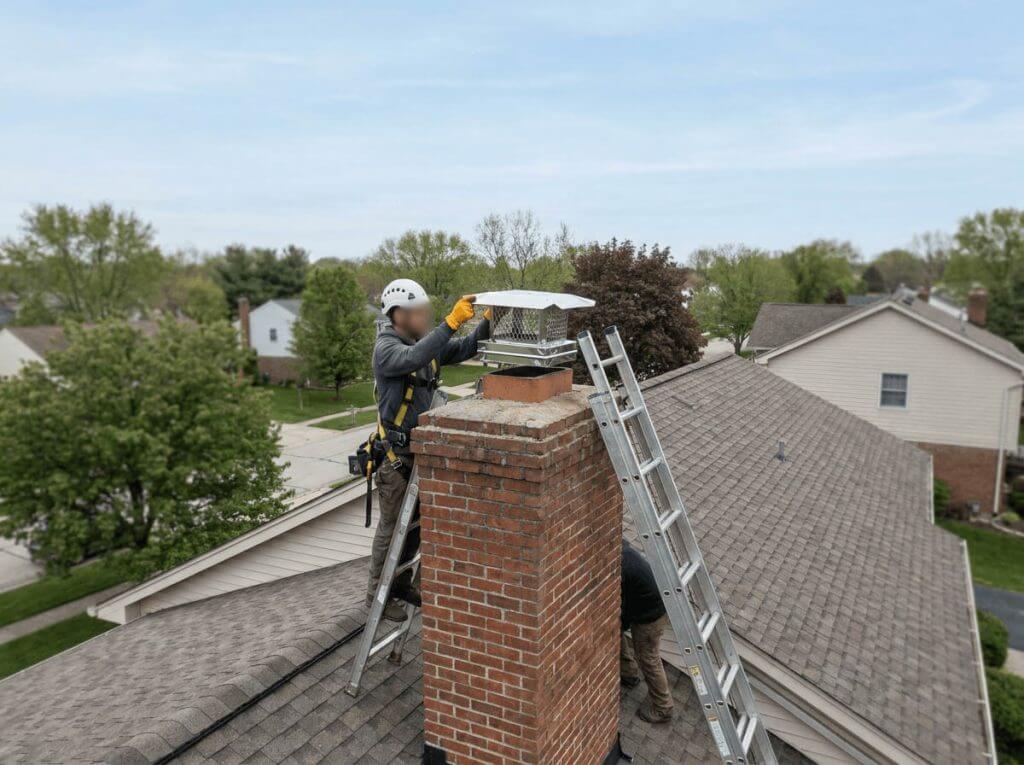
Cap your chimney. Raccoons love chimneys for denning, especially in late winter and early spring. A cap is a one-time install that prevents this entirely. If you already have raccoons in your chimney and there are likely babies, do not light a fire and do not call an exterminator. Call a wildlife rehabber or a humane wildlife exclusion service. Mom and babies need to be evicted together, or the babies will be stranded.
Seal attic, soffit, and porch entries. Same logic. Raccoons squeeze through smaller gaps than people expect.
How to prevent baby raccoon emergencies
Do not “evict” raccoons in March, April, May, June, or early July without checking for babies first. This is the single biggest cause of orphaned raccoon kits we see. A homeowner finds raccoons in the attic, hires someone to “remove them,” and a week later kits are crying inside the wall. By then it is often too late.
Do not cut down trees with visible cavities between February and July. Raccoon dens are usually in tree cavities or hollow snags. If tree work is unavoidable, hire an arborist who checks first.
Protecting your home from raccoon dens
Cover window wells with secure grates. A baby that falls in cannot climb out, and mom often gives up trying to retrieve it after several attempts.
Keep pet food and trash secure. Habituated raccoons den closer to humans, and human-adjacent dens are higher-risk for the kits.
Vaccinate your dogs against distemper and rabies, and keep cats indoors. This protects them and lets us focus on the wildlife instead of on dog-vs-raccoon conflicts.
If you find a raccoon mom and kits in your attic in spring, call a rehabber for advice before you do anything. There is almost always a humane eviction option that gets the family out together. The “trap mom and dump her in the woods” approach kills the kits.
A note from RFPS
We have helped over 20,000 animals since 2015. Raccoons are some of the hardest cases we take and also some of the most rewarding. They are extraordinary animals. They are also, legally and biologically, a different category from a baby bunny in a yard, and the protocols matter.
If you have any doubt, call before you act. Especially with raccoons. We would rather take fifty phone calls about kits that did not need help than receive one kit we cannot save, and we would much rather coach you through gloves-on containment than meet you in person with a bite to assess.
Thank you for caring enough to find this page.
Share this guide
If you know someone with a chimney, an attic, an outdoor cat, or a yard with old hollow trees, send them this link before the next eviction call. Prevention scales. One share might save a whole litter, and possibly a doctor’s bill.
Up next in the series
Coming next: [BRAD TO CONFIRM next species].
Browse the full Found a Baby series →
Ruffled Feathers Parrot Sanctuary Inc. is a 501(c)(3) parrot/wildlife rescue based in Louisville, Kentucky. We rely entirely on community donations. If this guide helped you, please consider making a donation so we can keep the lights on for the next call.
Some of our related content:

Where Hope Takes Flight