Ruffled Feathers Parrot Sanctuary Inc.
Where Hope Takes Flight


The RFPS Chronicles
July 22 Edition
Where Compassion Begins
Every day leaves behind footprints.
Most disappear without anyone noticing.
These wildlife rescue stories begin with moments that many people would otherwise walk past.
A pair of geese lands on a quiet pond. A young pigeon waits beside parents that will never fly again. A duck struggles against a tangle of fishing line while people walk the shoreline, unaware that every passing minute makes survival a little less likely. Somewhere, a volunteer quietly cleans cages before anyone else arrives. A sanctuary parrot greets the morning with the same familiar words it has spoken for years.
Individually, these moments seem small.
Together, they tell the story of what wildlife rescue really is.
People often imagine rescue as dramatic lights, frantic phone calls, and race-against-the-clock emergencies. Those moments certainly exist, and July 22 held more than its share of them. But most of this work happens long before the excitement begins. It starts when someone notices something that doesn’t look right. It starts when a passerby decides to stop instead of continuing on. It starts when compassion overrules convenience.
That simple decision changes everything.
The stories you’ll read in this edition span different years, different species, and different circumstances, yet they all share one thread. A duck survived because someone cared enough to make a call. A baby pigeon found safety because a stranger refused to leave it behind. Sanctuary volunteers gave their time expecting nothing in return except the chance to help another living creature. Around them, parrots filled the aviary with laughter, conversations, and the everyday routines that remind us life continues even between emergencies.
This is what July 22 has come to represent at Ruffled Feathers Parrot Sanctuary.
Not one extraordinary rescue.
Not one unforgettable photograph.
Not even one remarkable animal.
As you journey through this edition of The RFPS Chronicles, you’ll meet remarkable birds, dedicated volunteers, and ordinary people whose small decisions changed the course of another life. Some stories will make you smile. Others may break your heart for a moment. My hope is that every one of them leaves you looking at the natural world a little differently than you did before you turned this page.
Because every rescue has a beginning.
And more often than not…
It begins with someone who stopped long enough to notice
Compassion rarely announces itself with grand gestures.
More often, it arrives quietly in the form of someone who simply pays attention when everyone else keeps walking.
When most of these moments first happened, I never imagined they would become part of anything larger. They were simply another rescue, another bird needing care, another volunteer helping us make it through the day. At the time, none of it felt like history. It felt like Tuesday.
Years later, I realized those ordinary moments were the history of Ruffled Feathers Parrot Sanctuary. The quiet ones mattered every bit as much as the dramatic ones, and together they became who we are.
This Chronicle is my way of making sure they are not forgotten.
Thank you for spending part of your day with ours.
The RFPS Chronicles: Journey Through This Edition
Every day at Ruffled Feathers Parrot Sanctuary tells dozens of stories. Some last only a few minutes. Others continue for years. The events collected here all happened on July 22 across different years, creating a remarkable snapshot of what life at the sanctuary has looked like over time.
Today, you’ll journey through moments of laughter, heartbreak, education, and hope. You’ll meet parrots who have become beloved sanctuary ambassadors, wildlife whose lives changed because someone chose compassion, and the quiet heroes who make rescue possible behind the scenes.
This isn’t simply a collection of memories.
It’s a record of how ordinary people can make an extraordinary difference.
In This Edition
🐦 Morning at RFPS
Wake up with the sanctuary as familiar feathered faces greet another day.
🦆 The Duck That Wouldn’t Quit
A desperate call leads to one of the day’s most memorable rescues as fishing line turns into a life-threatening trap.
🌿 Wildlife Lesson
Discover why discarded fishing line and erosion-control netting have become hidden hazards for Kentucky’s waterfowl, and how a few simple actions can prevent needless suffering.
🕊️ The Little Pigeon Downtown
A heartbreaking discovery on a city sidewalk becomes a story of second chances and lifelong sanctuary.
🦜 Through the Aviary
Spend time with Stormy, Shazam, Ray, Zeus, Phoenix, and other unforgettable personalities who remind us that not every important moment begins with an emergency.
🤝 Quiet Heroes
Meet the volunteers, supporters, and compassionate strangers whose kindness made these stories possible.
🌎 Around the World
Explore fascinating wildlife and historical events that also share this date, placing the sanctuary’s story within a much larger world.
📚 The July 22 Archive
Browse every preserved Facebook post from this day in RFPS history, presented in chronological order as part of our permanent historical archive.
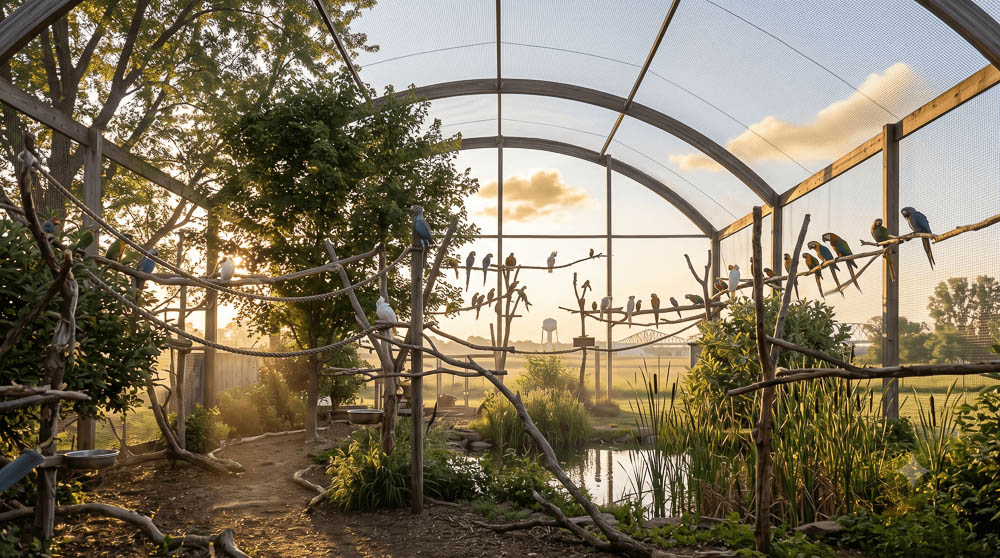
Illustration: AI-generated for Ruffled Feathers Parrot Sanctuary Inc.
The RFPS Chronicles: This Day at a Glance
Some days pass quietly. Others leave behind stories worth preserving.
Across the years, July 22 has become one of those remarkable dates in the history of Ruffled Feathers Parrot Sanctuary. Looking back through our archives, certain patterns begin to emerge. Wildlife in distress found compassionate strangers willing to stop and help. Sanctuary residents reminded us that joy often lives in the smallest moments. Volunteers quietly gave their time without expecting recognition. Educational conversations sparked from real rescues, helping countless people understand the challenges wildlife faces every day.
No one planned these moments.
They simply happened because people cared enough to act.
July 22 Through the Years
| Year | A Moment Worth Remembering |
|---|---|
| 2025 | A duck survived after becoming entangled in fishing line and a lure. A baby duckling found help in a parking lot. A Canada goose was freed from dangerous erosion-control netting. |
| 2024 | A rescued fawn eagerly accepted a bottle while recovering under human care, reminding us how quickly orphaned wildlife can learn to trust. |
| 2023 | A reminder that responsible parrot ownership begins long before bringing a bird home through education, preparation, and lifelong commitment. |
| 2022 | Shazam finally enjoyed peaceful time outdoors after weeks of fireworks kept the aviary closed for safety. |
| 2022 | Zeus and Phoenix reminded everyone that even sanctuary life has moments of comedy and personality |
| 2021 | A beautiful owl arrived safely for care, giving us another opportunity to admire one of Kentucky’s most impressive nocturnal hunters. |
| 2020 | Volunteer Kathie Hahn was recognized for the countless hours she devoted to caring for birds that depended on kindness every single day. |
| 2020 | An injured baby pigeon found beside its deceased parents began a new chapter that would ultimately lead to a permanent home at the sanctuary. |
| 2019 | Supporters rallied around Larry Bird while wildlife education continued with a look at Australia’s remarkable Wedge-tailed Eagle. |
By the Numbers
The common thread: Every story began because someone noticed an animal in need and chose to help.
Looking Back
When these events first appeared on social media, they were individual moments shared with friends and supporters. Years later, viewed together, they reveal something much larger.
They tell the story of a sanctuary that has never been defined by a single rescue.
Instead, it has been shaped by thousands of ordinary moments of compassion, repeated day after day, year after year.
And today, we begin with one phone call about a duck that refused to give up.
Chapter OneMorning at RFPS
An ordinary sunrise at the sanctuary sets the quiet stage for the rescues still to come.
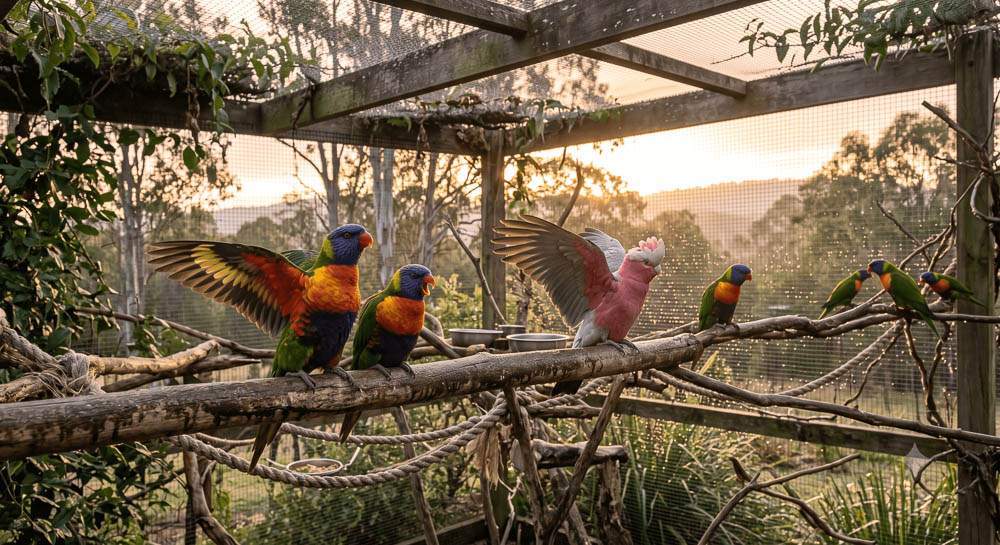
Morning light fills a flight aviary as brightly colored parrots settle into the rhythm of another day. Scenes like this are the quiet backdrop against which every rescue at the sanctuary begins.
Illustration: AI-generated for Ruffled Feathers Parrot Sanctuary Inc.
Long before the first emergency call, the sanctuary was already awake, and so was I, unaware that this ordinary morning was about to become anything but.
“Every rescue has a beginning. Sometimes it starts with an emergency. More often, it starts with an ordinary morning.”
Before the phone rang…
Before someone spotted a duck struggling against fishing line…
Before a frightened baby pigeon changed the course of its life…
There was simply another morning at Ruffled Feathers Parrot Sanctuary.
If you’ve never visited a parrot sanctuary, mornings have a rhythm all their own.
The sun has barely climbed above the trees when the first voices begin to echo through the aviaries. Some birds greet the day with whistles they’ve practiced for years. Others announce breakfast with dramatic enthusiasm, convinced they’re being neglected despite the food bowls already being prepared. A few simply enjoy reminding everyone that they’re awake and expect the rest of the world to acknowledge it.
After enough mornings, those sounds become more than noise.
They become home.
Every bird has its own routine.
Some wait patiently.
Some pace with excitement.
Some demand attention before breakfast.
Others are perfectly content to watch the world wake up around them.
That’s one of the things I’ve always loved about parrots.
Even after decades of caring for them, no two personalities have ever been exactly alike.
One of those familiar faces was Shazam.
For weeks, fireworks had interrupted one of his favorite parts of the day. What used to be a peaceful evening outside had become unpredictable. Loud explosions can send an entire aviary into panic, with startled birds crashing into perches, walls, or even one another. It isn’t worth the risk.
Finally, on this July day, things seemed quiet enough to let everyone enjoy the fresh air again. Watching Shazam relax outside wasn’t a dramatic rescue. No headlines would ever be written about it.
But moments like that matter.
Sometimes caring for animals means knowing when not to take a risk.
Sometimes the greatest success is an uneventful afternoon spent safely enjoying the sunshine.
Across the sanctuary, life continued much as it always had.
Zeus had spent weeks faithfully sitting on a clutch of dummy eggs, completely convinced she was raising the next generation. She had become so devoted to her imaginary family that leaving the nest had become a rare event. Then someone mentioned going outside.
Instantly, motherhood became far less important.
Within seconds she had climbed onto an arm, ready to trade her carefully guarded eggs for sunshine, fresh air, and probably a bath. After weeks of determined nesting, it turned out the promise of an afternoon outdoors was a pretty convincing argument. Sometimes parrots have a wonderful way of reminding us not to take life too seriously.
Nearby, Stormy was almost certainly carrying on a conversation with someone.
Nobody remembers exactly what he was saying that day.
Knowing Stormy, he probably didn’t care whether anyone understood him anyway.
Some parrots simply enjoy having the last word.
Others are perfectly happy if they get every word.
Not far away, Ray and Chase had discovered that a single grape was apparently valuable enough to fight over.
Neither bird seemed particularly interested in sharing.
For a few entertaining moments, that lone grape became the most contested piece of fruit in the entire sanctuary. Eventually, Chase claimed the prize, proving once again that parrots can turn almost anything into a game if another bird is willing to participate.
Looking back now, these moments seem almost insignificant compared to the rescues that would follow.
But this is what I hope people understand about wildlife rehabilitation.
The rescues don’t happen in isolation.
They happen in the middle of feeding schedules, cleaning cages, answering emails, washing dishes, mixing formula, preparing carriers, talking with veterinarians, helping adopters, thanking volunteers, and making sure dozens of permanent residents receive the same love and care they did yesterday.
Life doesn’t pause because the phone rings.
It simply asks you to make room for one more animal that needs help.
And on this particular July morning…
The phone was about to ring.
Chapter TwoThe Call That Changed the Day
A tangled duck, a wandering duckling, and one choice that mattered more than either of them knew.
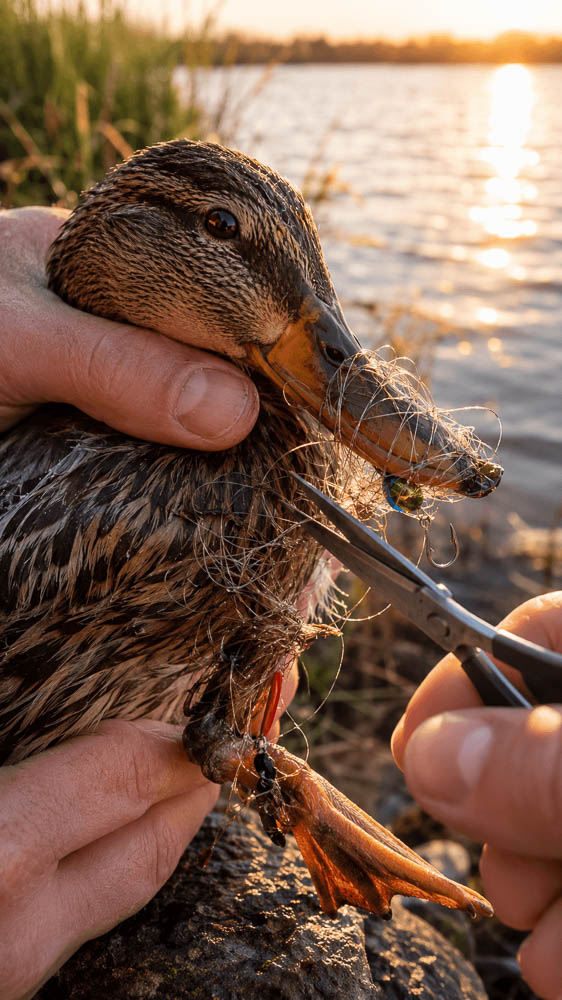
An exhausted duck rests safely after fishing line and a lure were carefully removed from its beak and leg. The bird remained overnight in a quiet environment so it could recover strength before the next stage of care.
Illustration: AI-generated for Ruffled Feathers Parrot Sanctuary Inc.
Some mornings give you a warning. This one simply rang the phone.
There are some wildlife calls you never forget.
Not because they’re the most dramatic.
Not because they make the evening news.
Simply because, for one animal, that phone call meant the difference between life and death.
On this July day, it began with a duck.
Someone had spotted it floating in a reservoir. At first glance it was obvious something was terribly wrong. The duck wasn’t swimming normally. It wasn’t diving. It wasn’t feeding. It was simply drifting, exhausted, toward the shoreline.
When rescuing wildlife, those small observations matter.
Healthy ducks are constantly moving. They feed, preen, dive beneath the surface, and quickly swim away when people approach. An animal that simply floats without purpose is often telling you something is very wrong.
This duck certainly was.
Fishing line had wrapped tightly around both its beak and one of its legs. The line had drawn them so close together that its leg and beak were nearly touching. Every movement tightened the tangle a little more. Eating had become nearly impossible. Swimming was awkward. Escaping the entanglement alone wasn’t going to happen.
Somehow…
It had survived long enough to reach the edge.
That alone was remarkable.
When I finally had the duck safely in hand, the full extent of the problem became clear.
This wasn’t a simple case of removing a loose piece of fishing line.
Every wrap had to be cut away carefully. One wrong move could tighten the line further or cause additional injury. Along with the fishing line came the lure that had become part of the trap. Once everything was removed, the duck finally had something it hadn’t experienced in quite some time.
Freedom.
I’ll never forget the moment it stopped struggling and simply let me work, as if some part of it understood I was trying to help.
It wasn’t ready to return to the wild just yet.
That night it stayed with us, somewhere quiet, warm, and safe, where it could rest without worrying about predators, waves, or the next struggle to find food. After everything it had endured, recovery was just as important as rescue.
But wildlife rescue has a way of reminding you that one emergency rarely arrives alone.
Before the day was over, another call came in.
This time it wasn’t an exhausted duck floating on a reservoir.
It was a tiny duckling, wandering alone through a parking lot.
Anyone who has watched a young duck knows how determined they can be. This one hurried from person to person as cars rolled past, instinctively searching for the protection that should have been waiting nearby. Instead, it found strangers.
Thankfully, one of those strangers chose compassion over convenience.
Someone stopped.
Someone picked it up.
Someone made the call.
That tiny decision transformed what could have become another tragedy into another chance.
It’s impossible to know how many people walked past that duckling before the right person came along.
What matters is that eventually…
They did.
Compassion had begun again the same way it always does, with someone who chose not to keep walking.
By now, the day already felt full.
Then the phone rang again.
This time, the patient wasn’t a duck.
It was a Canada goose.
And the danger wrapped around its beak wasn’t fishing line at all.
I had untangled a hundred birds before this one. I had no idea I was about to meet a kind of trap I’d never seen before.
Discarded fishing line is one of the most common human-made hazards facing waterfowl.
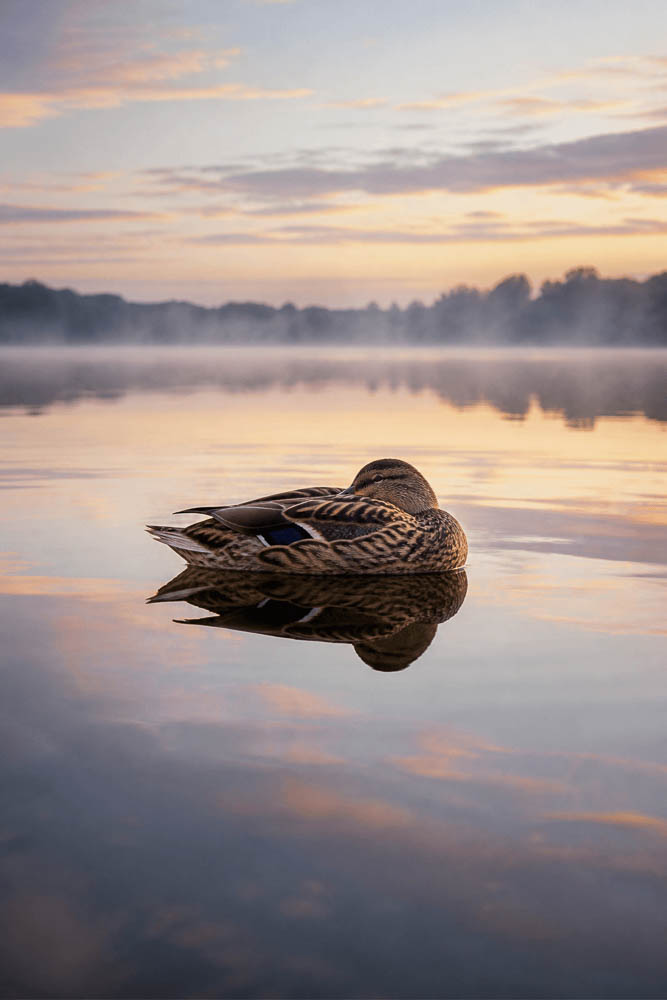
Illustration: AI-generated for Ruffled Feathers Parrot Sanctuary Inc.
While one duck finally rested safely, the hazards that nearly killed it were still waiting along every shoreline.
WILDLIFE LESSON
Not Every Trap Is Intentional
When most people think about wildlife becoming entangled, they picture discarded fishing line.
Unfortunately, waterfowl face many hidden hazards created by everyday human activity.
Fishing line, six-pack rings, balloon ribbon, plastic twine, and erosion-control netting can all become deadly traps. Animals don’t recognize these materials as dangerous. They simply try to eat, swim, or walk through them. Once wrapped around a beak, leg, or wing, every movement often makes the problem worse.
Many entangled birds survive only because someone notices them before it’s too late.
If you ever see a bird dragging fishing line or unable to use a wing or leg normally, contact a licensed wildlife rehabilitator as soon as possible. Avoid chasing the bird into open water if possible, as that can increase exhaustion and make rescue even more difficult.
WHAT YOU CAN DO
Contact a licensed wildlife rehabilitator as soon as possible.
Avoid chasing birds into open water if possible.
Report entangled wildlife promptly.
Chapter ThreeThe Goose and the Invisible Trap
An unfamiliar mesh around a goose’s beak uncovers a danger no one had noticed before.
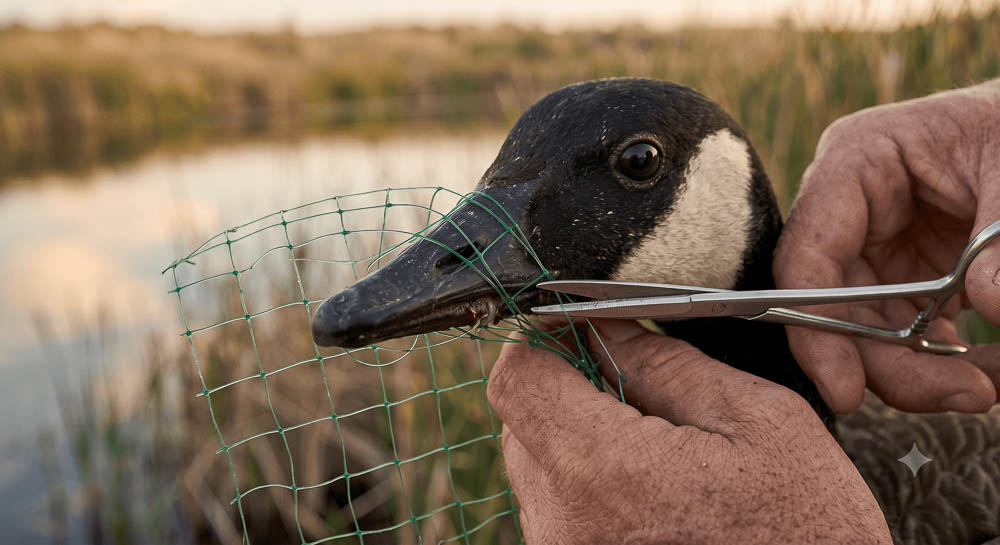
A simple piece of discarded plastic netting nearly became fatal for this Canada goose. Every wildlife rescue is also an opportunity to remind people that litter left behind can have devastating consequences for animals.
Photo: Ruffled Feathers Parrot Sanctuary Inc.
By the time the phone rang again that morning, I already knew this wasn’t going to be an ordinary rescue.
Just when it seemed the day might finally slow down, another call came in.
This time the patient was a Canada goose.
At first, it sounded familiar.
Whenever someone reports a goose with something wrapped around its beak, fishing line is usually the first suspect. Over the years, we’ve removed plenty of hooks, lures, and tangled monofilament from birds that simply happened to cross paths with someone else’s discarded gear.
But this wasn’t fishing line.
As soon as I got close enough to examine the goose, I realized I was looking at something I had never encountered before.
Wrapped tightly around its beak was a coarse, woven mesh unlike anything normally found near the water. The goose couldn’t open its mouth properly. Eating had become nearly impossible, and even drinking was difficult. Every day that material remained in place meant the bird grew weaker.
Carefully cutting it away, I tried to figure out what I was holding.
It wasn’t monofilament.
It wasn’t rope.
It wasn’t twine.
It looked more like the plastic mesh landscapers use when establishing new lawns and preventing soil erosion.
At the time, I didn’t even know what it was called.
What I did know was that this wasn’t an isolated incident.
This goose wasn’t the first one I’d seen tangled in the material.
It wasn’t even the second.
By then, I had already removed the same mesh from roughly a dozen different waterfowl across the city. That was enough to convince me this wasn’t bad luck.
It was becoming a pattern.
That’s when I knew this was bigger than one goose.
Instead of simply treating the goose and moving on, I decided to ask a question.
I reached out to friends in landscaping, hoping someone could identify the material and explain who manufactured it. If we understood what it was and where it was being used, maybe we could help prevent more birds from becoming trapped in it.
Wildlife rescue isn’t only about responding after something goes wrong.
Whenever possible, it’s about finding the cause and stopping the next rescue from ever being necessary.
Sometimes the greatest success isn’t saving one animal.
It’s preventing ten more from needing to be saved.
Looking back now, that goose taught me something I hadn’t expected.
Nature adapts remarkably well to natural dangers.
Predators.
Storms.
Harsh winters.
Those challenges have always been part of life.
What wildlife struggles to understand are the dangers we accidentally introduce into the landscape. A sheet of plastic mesh doesn’t exist in nature. To a hungry goose, it isn’t obviously dangerous. It’s simply another obstacle encountered while trying to eat.
That realization changed the way I looked at rescue work.
Every tangled bird is telling a story.
Sometimes that story points to a much larger problem than the individual animal standing in front of you.
And if we’re willing to listen, those animals can teach us how to protect countless others in the future.
The mesh came off that afternoon. The question it left behind stayed with me for years.
A single strand of plastic mesh can undo everything an animal needs to survive: the ability to eat, to drink, to breathe.
Behind the Rescue
One of the biggest misconceptions about wildlife rescue is that speed is always the most important thing. It isn’t. The moment we arrive, we’re already making decisions that most people never notice. Is the animal exhausted? Which direction will it run if we approach from here? Is there traffic nearby? Will one more chase make the situation worse than the injury itself?
Sometimes doing less is actually doing more. Experience has taught me that every extra minute of unnecessary stress matters. A frightened goose can burn through precious energy long before anyone ever lays a hand on it. That means our job isn’t just to catch the animal. It’s to catch it in the safest way possible.
The rescue people see often lasts only a few seconds. The rescue decisions started long before that.
A goose with something wrapped around its beak.
An exhausted bird whose survival depended on keeping stress to an absolute minimum.
Experience teaches us that the safest rescue often looks like the slowest one.
🐦 Canada geese are far more perceptive of people than they appear. Studies of geese and their relatives have found that these birds can recognize and remember individual human faces, distinguishing between people who have treated them well and those who have harassed or chased them. A goose that has had a frightening encounter may hiss or flee at the sight of that same person weeks or even months later, while remaining calm around familiar, gentle handlers. This long memory is one reason experienced rescuers work slowly and quietly, a calm approach today can make the next encounter far less stressful for the bird.
Erosion-Control Netting: A Hidden Hazard
Erosion-control netting is commonly used on newly seeded hillsides, construction sites, road projects, and landscaping to hold soil in place while vegetation becomes established. It serves an important purpose, but when it becomes loose, damaged, or is left exposed after a project is complete, it can become a serious hazard for wildlife.
Waterfowl are especially vulnerable. As geese graze, they may push their beaks through the mesh or become entangled while pulling at fresh vegetation. Once caught, every attempt to free themselves can tighten the material further, making it difficult to eat or drink.
If you notice loose erosion-control netting near ponds, creeks, parks, or stormwater basins, consider reporting it to the property owner or local municipality. Small maintenance issues can prevent large wildlife tragedies.
Sometimes conservation begins long before an animal needs rescuing.
🌿 Plastic netting and discarded line are among the most persistent human-made threats to waterfowl. Because materials like erosion-control mesh and monofilament fishing line resist breaking down, they can linger in the environment for years after they are forgotten. Geese and ducks encounter these materials while feeding on grass and aquatic plants, and once a beak, leg, or wing becomes caught, every struggle to escape tightens the tangle. Wildlife agencies note that entanglement in litter is a leading cause of injury in urban and suburban waterfowl, and that simply removing loose netting and line from shorelines prevents a great deal of needless suffering.
One sanctuary. One material. A dozen tangled birds, and counting.
Early on, I thought every animal I couldn’t fix was a failure. A wing that wouldn’t heal. A goose I reached too late. I carried those losses like they were mine alone to answer for.
Years taught me something gentler. You’re not the only thing standing between an animal and the world. You’re one link in a long chain of people who noticed, who called, who cared. Some days your job is to heal. Some days it’s simply to make sure a frightened creature isn’t alone.
I stopped measuring myself by the ones I couldn’t save. I started measuring by whether I showed up.
You will not save them all. Show up anyway.
Chapter FourThe Little Pigeon Downtown
A grieving pigeon on a city sidewalk finds an unexpected kind of forever.
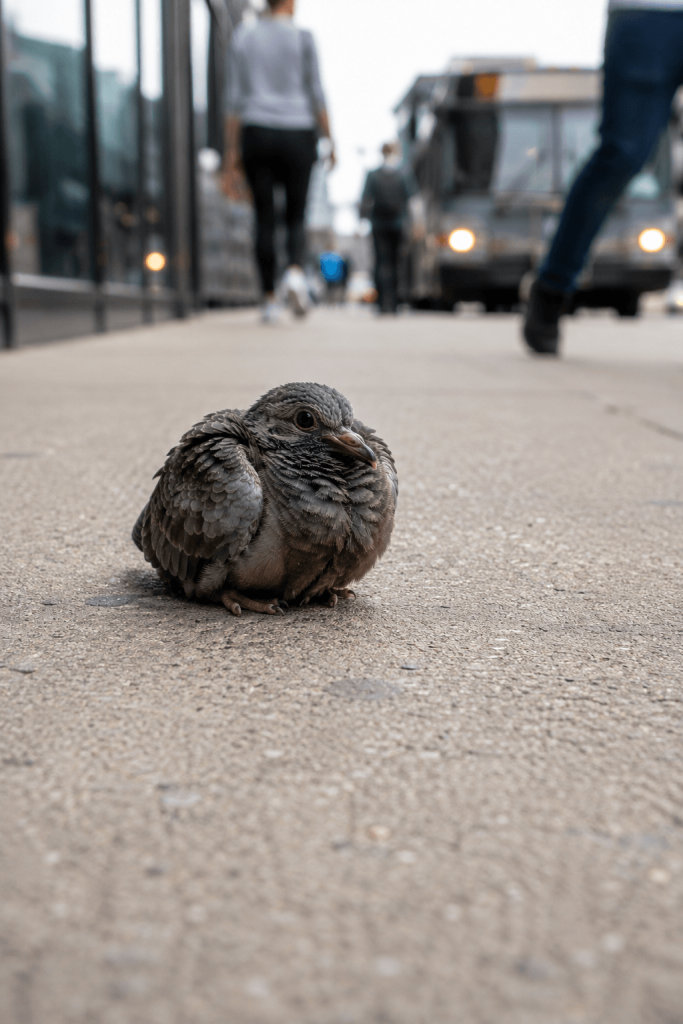
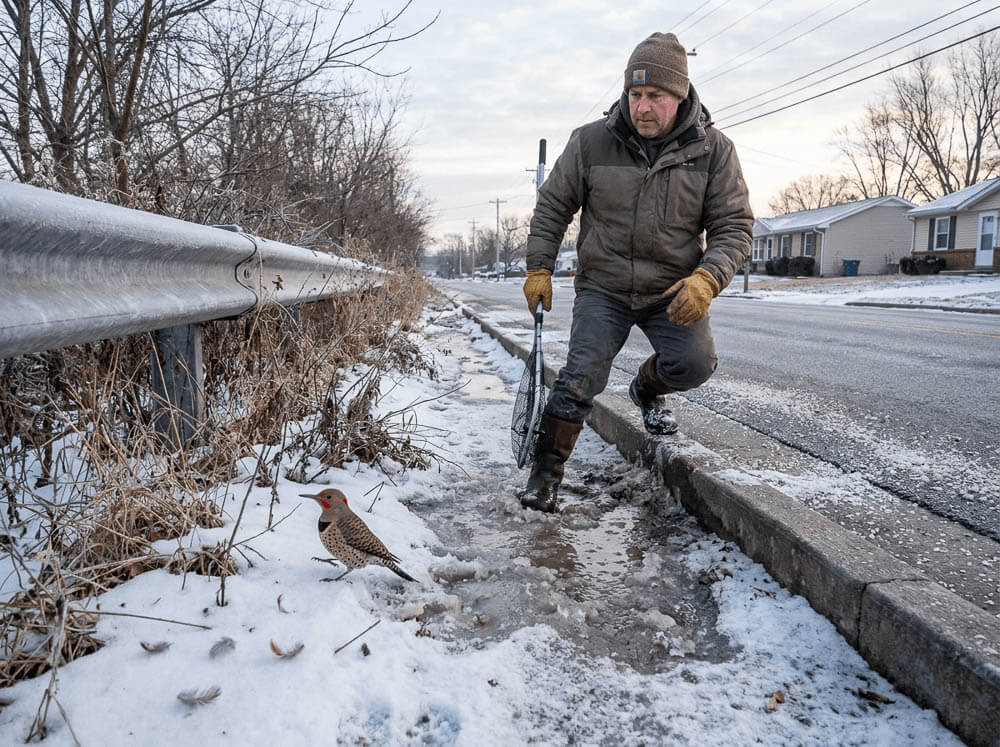
A young mourning dove waits alone on a downtown sidewalk after losing its parents. A passerby’s decision to stop instead of walking by is what gave this fragile bird a second chance.
Illustration: AI-generated for Ruffled Feathers Parrot Sanctuary Inc.
Downtown Louisville is the last place you expect a rescue to begin, which is exactly why almost everyone walked past it.
Some rescues begin with flashing lights.
Others begin with silence.
This one started on a city sidewalk.
Someone noticed a tiny pigeon sitting in the middle of downtown Louisville.
It wasn’t flying away.
It wasn’t hopping after its parents.
It wasn’t even trying to escape.
Instead, it stayed exactly where it was.
When they looked closer, they understood why.
Its parents had been struck and killed.
The little pigeon hadn’t left.
It simply stayed beside them, crying.
It’s a scene most people would walk past without ever noticing. Downtown streets are busy places. People have appointments to keep, buses to catch, and somewhere else to be. Wildlife often becomes part of the background.
But not that day.
That day, someone stopped.
Someone took a closer look.
Someone realized this wasn’t just another pigeon.
It was a frightened baby that had no idea its world had changed forever.
That simple act of kindness brought the little bird to us.
Whenever a young bird arrives, there’s always a mixture of hope and uncertainty. Some injuries heal beautifully. Others don’t. Until they’re examined, you simply don’t know which story you’re about to become part of.
A veterinary examination confirmed what we had feared.
The injury to the wing was serious.
There was little chance this pigeon would ever fly the way a wild pigeon needs to fly.
I remember sitting with that news for a while before I could decide what came next.
For many wild animals, that would have been the end of the story.
But sometimes rescue changes what the ending looks like.
Not every success is measured by release.
That can be one of the hardest things for people outside wildlife rehabilitation to understand.
Everyone wants the animal to fly back into the wild.
So do we.
Nothing compares to opening a carrier and watching a healthy bird disappear into the sky where it belongs.
But rescue isn’t about forcing every story to end the same way.
It’s about giving every animal the best possible future, even when that future looks different than we hoped.
For this little pigeon, freedom wasn’t going to mean soaring over the Louisville skyline.
Freedom became something else.
A safe place.
Regular meals.
Veterinary care.
Other birds for company.
A life without hunger, fear, or traffic.
A permanent home where disability didn’t define worth.
It simply defined the kind of care that bird would need for the rest of its life.
People sometimes ask whether it’s difficult to keep an animal that can never return to the wild.
The honest answer is…
Sometimes.
Every permanent resident is a reminder that nature doesn’t always give us the ending we hoped for.
But they’re also reminders of something far more important.
Every life still has value.
Even when it can never be exactly what it once was.
That little pigeon never knew the thousands of people who would eventually see its story.
It never knew how many hearts it would touch.
It never understood that its journey would become part of the history of this sanctuary.
It simply knew that, on the worst day of its life…
Someone stopped.
Someone picked it up.
Someone cared.
Sometimes…
That’s enough to change everything.
That little pigeon never flew again. Somehow, it still managed to travel farther than any of us expected.
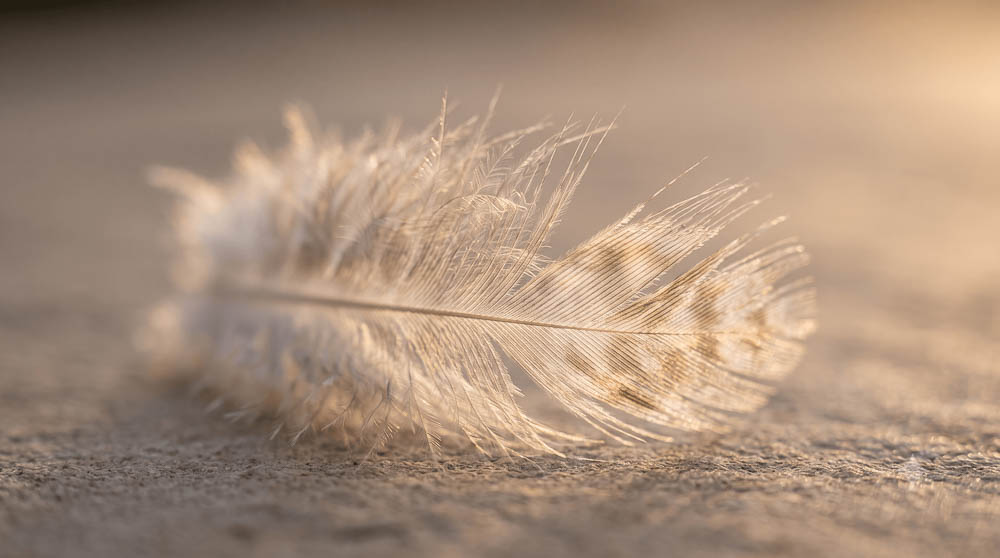
Not every rescued animal can return to the wild. Every one of them still deserves a future.
Illustration: AI-generated for Ruffled Feathers Parrot Sanctuary Inc.
🕊 Pigeons are among the few birds that feed their young a substance often called “crop milk.” Produced in the lining of the crop by both mothers and fathers, this thick, protein-rich secretion nourishes newly hatched squabs during their first days of life, much as mammal milk nourishes infants. This shared parenting is part of why pigeons are such successful, adaptable birds across the world’s cities. It also means an orphaned or injured pigeon that can no longer fly is not a lost cause: with reliable food and shelter, a flightless pigeon can live a comfortable life in human care for well over a decade.
When Release Isn’t Possible
One of the most common misconceptions about wildlife rehabilitation is that every rescued animal can eventually return to the wild.
Unfortunately, that’s not always possible.
For birds, the ability to fly is often the difference between life and death. Even a wing that appears mostly healed may never provide the speed, maneuverability, or endurance needed to escape predators or find food.
When release isn’t humane or safe, licensed rehabilitators must make difficult decisions. In some cases, permanent placement at an educational facility or sanctuary provides the animal with an excellent quality of life. In others, humane euthanasia may be the kindest option if suffering cannot be relieved.
Every case is different.
The goal is never simply to keep an animal alive.
The goal is to give that animal the best life possible, whatever that may look like.
For birds, the ability to fly is often the difference between life and death. Even a wing that appears mostly healed may never provide the speed, maneuverability, or endurance a bird needs to escape predators in the wild.
Chapter FiveThrough the Aviary
Between feedings and feathers, the sanctuary’s smaller moments turn out to matter most.
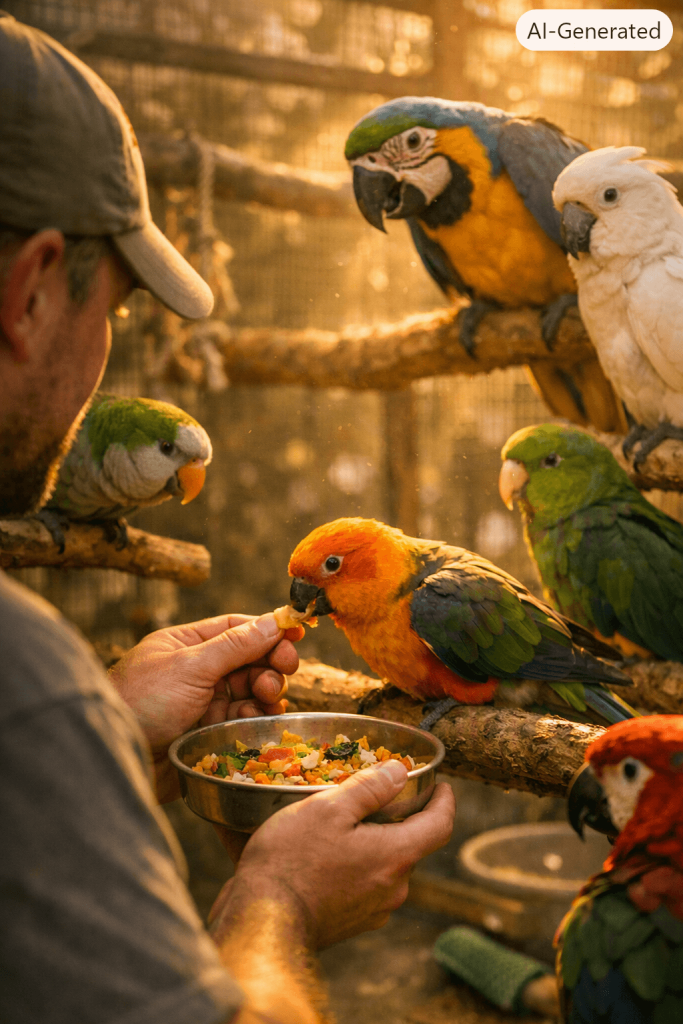
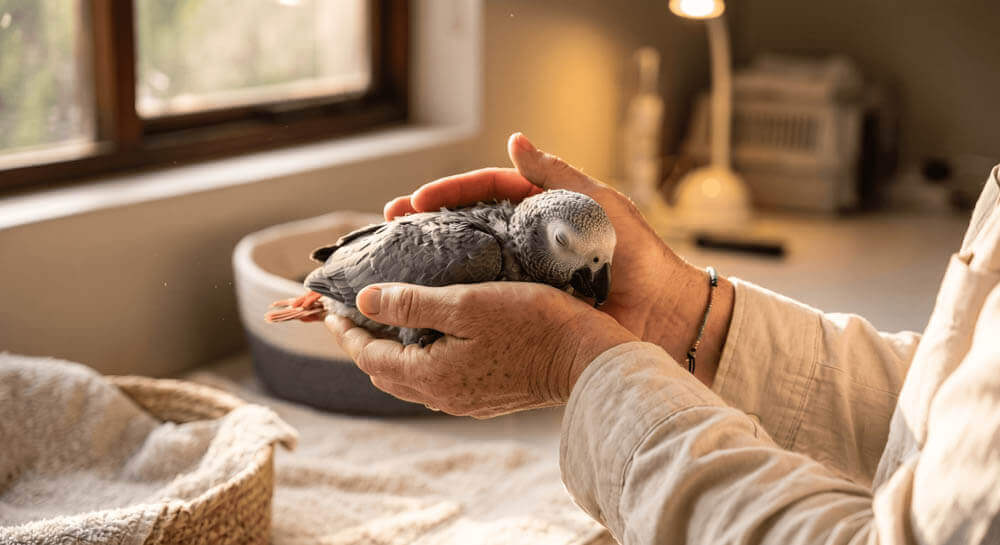
A volunteer hand-feeds sanctuary parrots during the quiet routine of evening care. Moments like these rarely make headlines, yet they are the daily work that keeps every resident healthy.
Illustration: AI-generated for Ruffled Feathers Parrot Sanctuary Inc.
Ask anyone what a wildlife sanctuary looks like, and they’ll picture the rescues. They rarely picture the grape two parrots were willing to fight a war over.
Not every important moment begins with an emergency.
One of the biggest misconceptions about wildlife rescue is that every day is filled with flashing lights, frantic phone calls, and dramatic rescues.
The truth is much quieter.
Most days are built around routines.
Food bowls are washed.
Fresh water is carried from enclosure to enclosure.
Perches are scrubbed clean.
Special diets are prepared.
Medications are measured.
Someone sweeps feathers while someone else mixes formula for a baby that isn’t quite ready to feed itself.
Long before the next rescue call arrives, dozens of birds already depend on those ordinary routines.
The work never really stops.
And neither do the personalities.
If you’ve spent any amount of time around parrots, you learn very quickly that every one of them has an opinion about how the day should unfold.
Some are comedians.
Some are drama queens.
Some become tiny supervisors who seem convinced every chore would be done better if they were in charge.
Others simply want to know what you’re doing every minute of the day.
Those personalities are what transform a sanctuary into something much more than a collection of cages.
They create a community.
Shazam
For Shazam, the simple privilege of spending time outdoors had been missing for weeks.
Fireworks had turned peaceful evenings into something unpredictable. A single unexpected explosion can send an aviary full of parrots into panic. Wings collide with wire. Birds crash into perches. Injuries happen in seconds.
Waiting wasn’t frustrating.
It was responsible.
So when July 22 finally brought a quiet evening, it felt like a victory.
Watching Shazam relax in the fresh air probably didn’t look extraordinary to anyone driving past.
To us…
It was exactly the kind of ordinary day we’d been hoping for.
Waiting wasn’t frustrating. It was responsible.
Zeus
Zeus had spent weeks faithfully incubating a collection of dummy eggs.
She took the job seriously.
Very seriously.
Leaving the nest had become almost unthinkable.
Until someone casually mentioned going outside.
Apparently sunshine outranked motherhood.
Within moments she climbed onto an arm, completely prepared to abandon her imaginary family in exchange for fresh air and what would almost certainly become an afternoon bath.
Parrots have an incredible ability to humble any attempt at taking life too seriously.
Just when you think you understand exactly what they’re going to do…
They remind you they’re writing the script too.
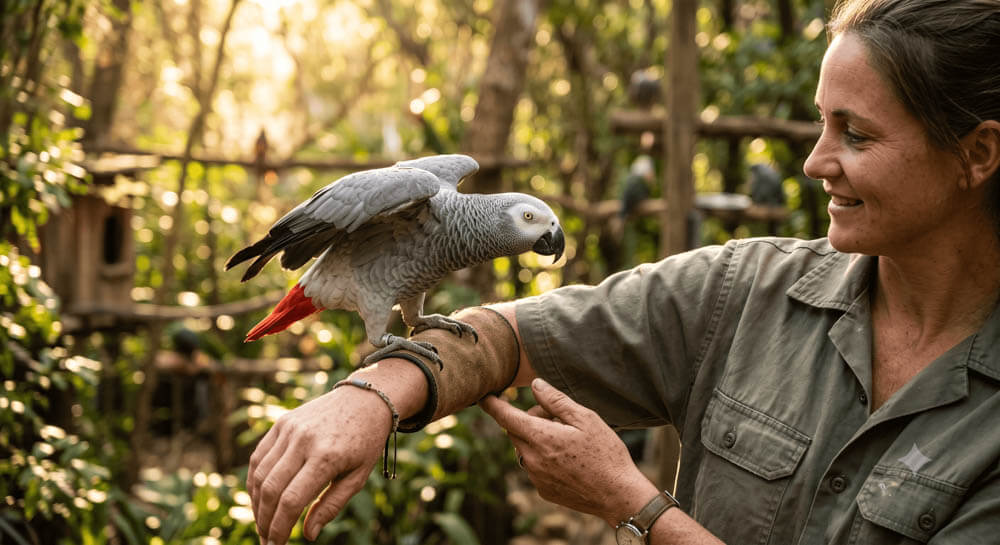
Stormy
Stormy rarely met a quiet moment he couldn’t improve with conversation.
Whether anyone understood him was almost beside the point.
Talking wasn’t simply something Stormy did.
It was part of who he was.
A single photograph captured him in mid-sentence that day.
No one remembers exactly what he was saying.
Looking at the picture now…
It almost doesn’t matter.
Anyone who has ever lived with an African Grey can probably imagine the rest of the conversation for themselves.
Whether anyone understood him was almost beside the point.
Ray and Chase
Some lifelong friendships are built over years.
Others are apparently tested over a single grape.
On this particular day, Ray and Chase decided one piece of fruit deserved everyone’s full attention.
For a few unforgettable moments, that lonely grape became the center of the universe.
Chase eventually claimed the prize.
Ray probably believed justice had not been served.
Life moved on anyway.
Moments like that one remind me why I’ve never once regretted this life, exhausting as it is.
Parrots have a wonderful way of reminding us that joy often hides inside moments adults might otherwise overlook.
Why These Moments Matter
People often ask me which rescue I’ll remember the most.
The honest answer surprises them.
I remember the rescues.
But I also remember mornings like this.
The conversations.
The laughter.
The routines.
The personalities.
The quiet moments when nothing remarkable happened except that everyone was safe, healthy, and exactly where they were supposed to be.
Those are the days that keep you going.
Because if rescue work were only emergencies, no one could do it for very long.
It’s these ordinary moments that remind you why every late-night phone call, every difficult decision, and every mile driven is worth it.
The sanctuary isn’t built only on the lives we save.
It’s built on the lives we share every single day.
The cages would be cleaned again tomorrow. The grape, no doubt, re-litigated. And somewhere out there, another phone was already waiting to ring.
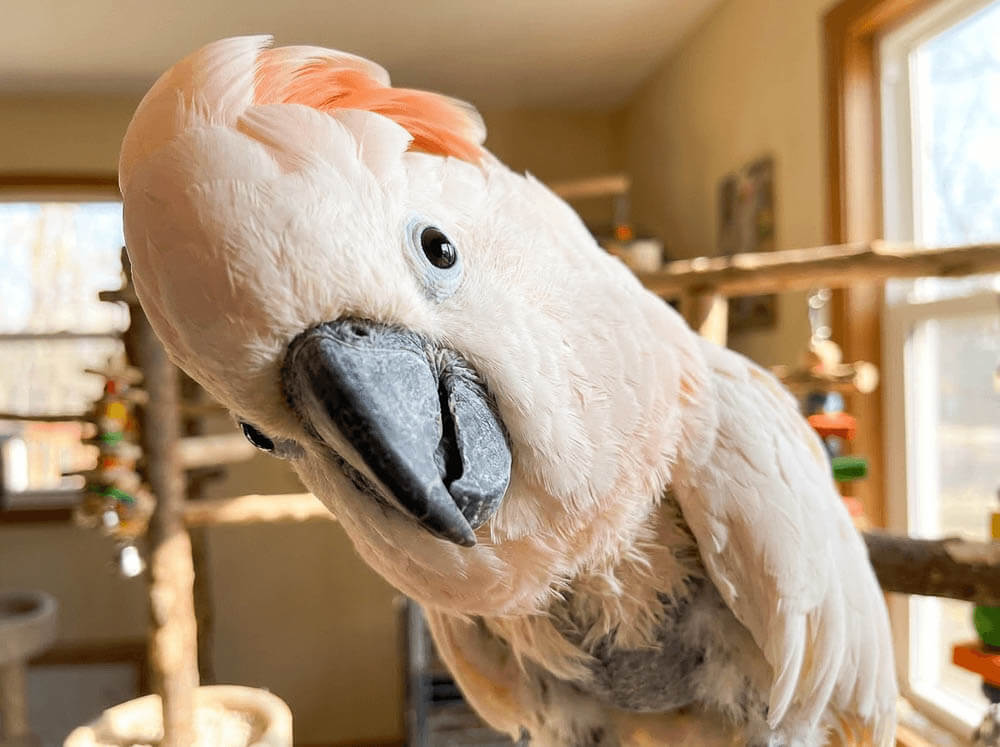
🦄 African Grey parrots do far more than mimic the sounds around them. Decades of research, most famously the work with a parrot named Alex, suggest that these birds can learn to associate spoken words with real objects, colors, shapes, and even simple number concepts when carefully taught. Some individuals appear to grasp ideas like “same” and “different,” and can answer questions about the things in front of them. This intelligence, paired with lifespans that can reach fifty years or more, is exactly why parrots need lifelong companionship and mental enrichment rather than simply food and a cage.
From the AviaryWhat People Don’t Always See
Visitors often notice the colorful feathers, the playful personalities, and the birds that eagerly greet them.
What they don’t always see are the countless hours behind those moments.
Preparing specialized diets.
Cleaning enclosures.
Monitoring weight changes.
Scheduling veterinary appointments.
Repairing toys.
Rotating enrichment.
Watching for the smallest changes in behavior that might signal illness.
Most of wildlife rescue happens outside the spotlight.
Most of sanctuary work happens between the photographs.
And that’s perfectly okay.
Because the birds don’t care whether anyone is watching.
They simply care that someone shows up.
Chapter SixQuiet Heroes
Behind every rescue stands a quiet chain of people who simply chose to help.
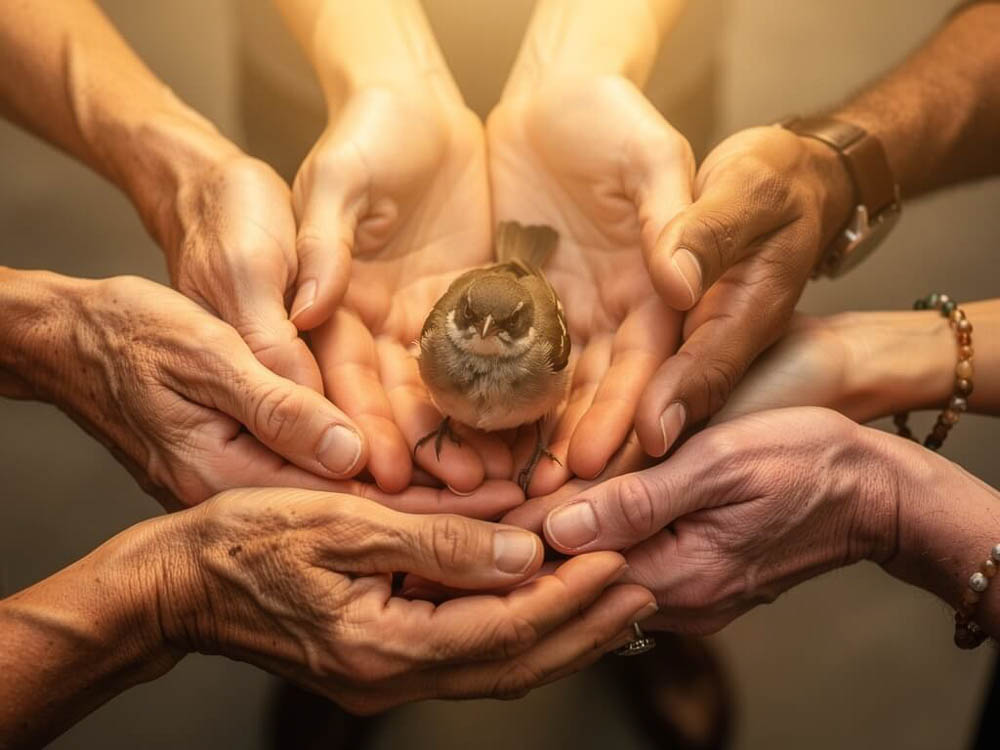
Several pairs of hands gather around a small rescued songbird. Every successful rescue depends on a chain of people, the one who noticed, the one who called, and the one who drove.
Illustration: AI-generated for Ruffled Feathers Parrot Sanctuary Inc.
The person holding the animal in the photograph is almost never the one who saved it.
There is a common misconception about wildlife rescue.
People often imagine a single rescuer arriving just in time, scooping up an injured animal, and somehow making everything better.
Real rescue almost never works that way.
Behind every successful rescue is a long chain of people who may never meet one another.
Someone notices an animal in trouble.
Someone else makes the phone call.
A dispatcher answers.
A volunteer changes their plans.
A driver offers transportation.
A veterinarian prepares for another patient.
A donor pays for food or medication without ever knowing exactly which life they helped save.
Every rescue is built on dozens of quiet acts of kindness.
Most of them happen long before the rescuer ever arrives.
That’s why I’ve never believed these stories belong to just one person.
They belong to everyone who chose to care.
Quiet Heroes
A Volunteer Named Kathie
There wasn’t a spotlight.
There wasn’t a television camera.
There wasn’t even an audience.
There was simply another animal that needed help.
Like so many volunteers, Kathie gave something that can never be replaced. Her time. Time spent making phone calls. Time spent transporting wildlife. Time spent waiting. Time spent helping animals that would never know her name.
Volunteers rarely ask for recognition. In fact, many seem almost uncomfortable when attention is turned toward them. They’ll usually tell you they were “just helping.” But anyone who has spent years in rescue knows better. Without volunteers, many animals would never make it to safety at all.
Some rescues happen because someone knew exactly what to do. Others happen because someone simply refused to ignore what they saw. Both kinds of people are heroes.
Kathie was one of them.
This is where compassion begins, not in grand gestures, but in the quiet people who simply show up.
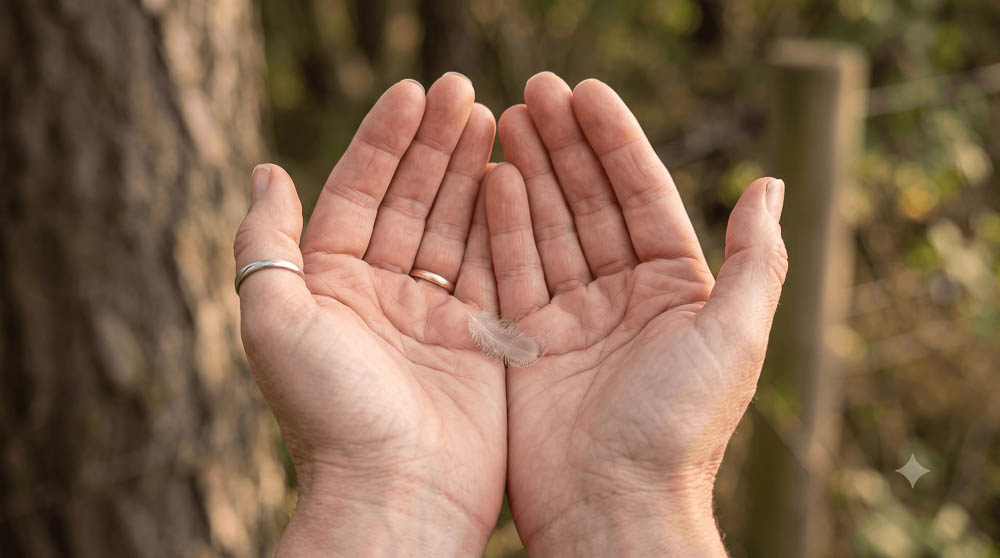
Illustration: AI-generated for Ruffled Feathers Parrot Sanctuary Inc.
Compassion Is Contagious
One of the unexpected things about rescue work is how often kindness inspires more kindness.
A person who stops for an injured bird today may become the person who calls again next year.
Children who watch a rescue often grow into adults who teach their own families to respect wildlife.
Volunteers encourage other volunteers.
Neighbors help neighbors.
Communities slowly become places where helping animals is simply part of who they are.
Compassion spreads quietly.
It doesn’t need advertising.
It doesn’t ask for applause.
It simply grows one person at a time.
Looking back over the stories in this edition, there’s a pattern that’s impossible to miss.
The duck survived because someone stopped.
The goose survived because someone cared enough to make a phone call.
The little pigeon found safety because someone refused to walk away.
Even the joyful moments inside the aviary happened because people continue showing up every single day.
Different animals.
Different circumstances.
The same decision.
Someone cared.
Compassion tends to spread person to person: someone who stops for an injured bird today often becomes the person who calls for help again next year, and children who witness a rescue frequently grow into adults who teach their own families to respect wildlife.
Compassion spreads quietly. It doesn’t need advertising. It doesn’t ask for applause.
The Real Measure of Success
People sometimes ask how success is measured in wildlife rescue.
Is it the number of rescues?
The number of releases?
The number of animals cared for?
Those numbers matter.
But they never tell the whole story.
The real measure of success is much harder to count.
It’s the family that now knows what to do when they find an orphaned animal.
It’s the child who grows up believing wildlife deserves kindness.
It’s the volunteer who decides to answer one more phone call after an already long day.
It’s the community that slowly learns compassion isn’t something reserved for people.
It extends to every living creature that shares this world with us.
Those things don’t fit neatly into a spreadsheet.
But they’re the reason this work matters.
Looking Ahead
As this July day came to a close, the sanctuary grew quieter.
The rescues had been completed.
The birds settled onto their perches.
The day’s patients were safe.
Tomorrow would almost certainly bring another phone call.
Another injured animal.
Another unexpected challenge.
That’s the nature of rescue work.
You never know what tomorrow will ask of you.
You simply hope you’ll be ready when it does.
And thanks to the people who quietly support this mission every day…
We’ll answer that call.
Just as we always have.
You’ll probably never learn their names. The animals never do either, and it has never once made the difference smaller.
Quiet Heroes
Every Rescue Belongs to a Community
Wildlife rescue is often associated with the person holding the animal in the photograph.
In reality, every successful rescue is the result of countless people working together behind the scenes.
Volunteers donate their time.
Veterinarians provide medical care.
Supporters contribute supplies and funding.
Neighbors make the phone call that starts the rescue.
No single person can save every animal.
But together, a community can save far more than any one individual ever could.
No single person can save every animal. But together, a community can save far more.
The RFPS Chronicles Chapter Seven Around the World
From a Kentucky pond to the Australian sky, compassion turns out to have no borders.
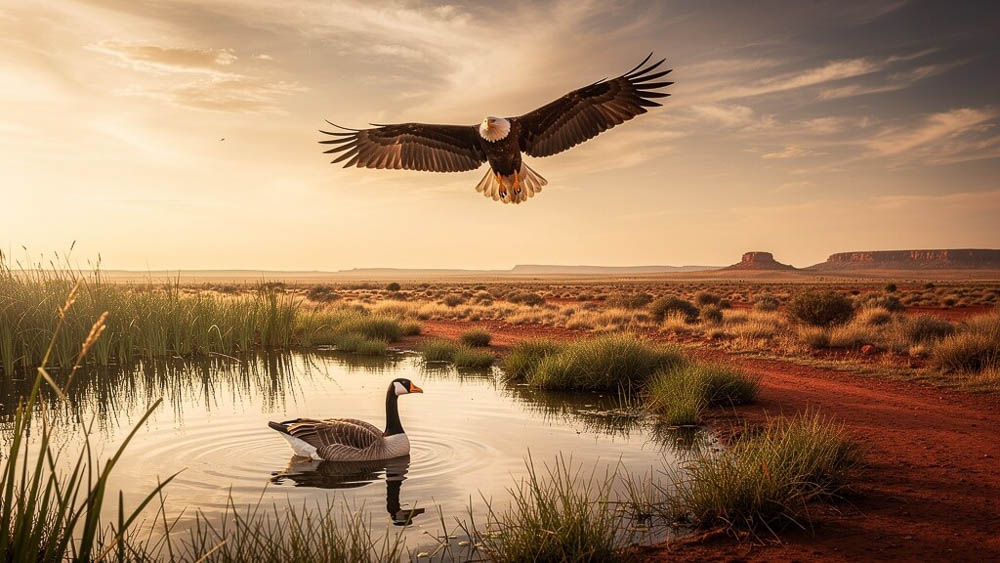
A bald eagle glides over a quiet wetland while a Canada goose drifts below. The image reflects the chapter’s larger theme: wildlife everywhere faces the same human-made hazards, no matter the species or the continent.
Illustration: AI-generated for Ruffled Feathers Parrot Sanctuary Inc.
A goose in Kentucky and an eagle over the Australian outback have more in common than you might think.
Rescue work often begins close to home.
A duck floating helplessly in a local reservoir.
A goose struggling beside a neighborhood pond.
A baby bird sitting alone on a downtown sidewalk.
But compassion should never stop at the edge of our own community.
Animals throughout the world face many of the same challenges we see here every day. Habitat loss, human development, discarded materials, illegal wildlife trade, and simple misunderstanding can place extraordinary pressure on species that have nowhere else to go.
Learning about those animals reminds us that wildlife protection is not only a local responsibility.
It is a shared one.
While today’s rescue unfolded in Kentucky, history was being written around the world in many different ways.
- 1862, President Lincoln told his cabinet he would issue the Emancipation Proclamation, a reminder that history’s greatest turning points often begin with one person deciding to do what is right. (History.com)
- 1894, The world’s first automobile race set out from Paris to Rouen, opening a new era of how far people could travel, even as some journeys, like a rescue, are measured in feet, not miles. (History.com)
- 1933, Aviator Wiley Post became the first person to fly solo around the world, proving that a single determined effort can circle the entire globe. (History.com)
- 2005, March of the Penguins opened across the United States, reminding millions how far our compassion for wildlife can carry, from Antarctic ice to a Kentucky pond. (History.com)
- 2025, While history remembered great milestones, a rescued Canada goose in Louisville reminded us that compassion begins close to home.
Australia’s Wedge-Tailed Eagle
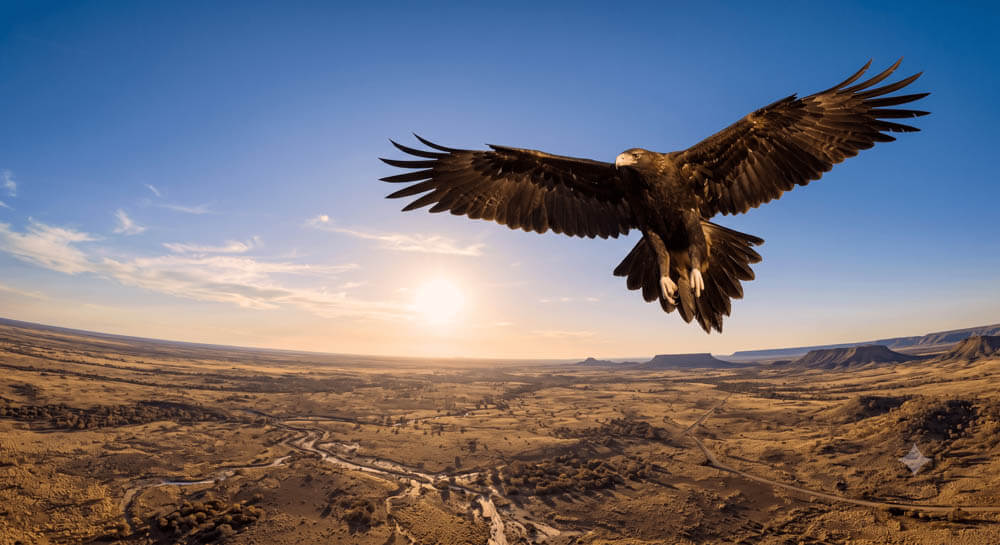
Few birds command the sky quite like the Wedge-tailed Eagle.
Native to Australia, this enormous bird of prey is named for the unmistakable wedge-shaped tail visible when it soars overhead. Its long wings allow it to ride rising currents of warm air for hours, often appearing almost motionless high above the landscape.
From the ground, it may look peaceful.
But the Wedge-tailed Eagle is a powerful hunter.
Its keen eyesight allows it to search vast areas for prey, while its strong feet and curved talons are built for capturing and carrying food. Like many birds of prey, it also scavenges when the opportunity arises, helping remove animal remains from the environment.
That role may not sound glamorous, but it is essential.
Nature wastes very little.
By consuming carrion, scavengers help recycle nutrients and reduce the spread of disease. They are part of a larger system in which every species has a job, even when that job is not always understood or appreciated.
The Wedge-tailed Eagle is named for the unmistakable wedge-shaped tail visible when it soars overhead. Its long wings let it ride rising currents of warm air for hours, often appearing almost motionless high above the landscape.
Misunderstood Predators
Large birds of prey often inspire both admiration and fear.
People see their talons, powerful beaks, and impressive size and assume they must be dangerous or aggressive. In reality, most wild raptors prefer to avoid people whenever possible.
They are not villains.
They are not cruel.
They are animals surviving exactly as nature designed them to survive.
Predators help maintain balance by controlling populations of other animals. Without them, ecosystems can quickly become unstable. The loss of a top predator can affect everything from prey numbers to vegetation and even the health of waterways.
Protecting predators is not about choosing one species over another.
It is about protecting the relationships that keep entire ecosystems functioning.
Despite their talons and size, most wild raptors prefer to avoid people whenever possible. They aren’t villains; they’re animals surviving exactly as nature designed them to.
They are not villains. They are not cruel. They are animals surviving exactly as nature designed them to survive.
Different Continents, Familiar Problems
A Wedge-tailed Eagle soaring over the Australian countryside may seem far removed from the animals arriving at RFPS.
Yet many of the threats are surprisingly familiar.
Wildlife encounters roads.
Animals become caught in fencing and discarded materials.
Habitats are divided by expanding development.
Young animals are sometimes taken by people who mistakenly believe they have been abandoned.
Injured wildlife depends on someone recognizing that something is wrong and contacting the right people for help.
The species may change.
The landscape may change.
The need for compassion does not.
It reminded me that the goose on our little Kentucky pond was part of something far larger than I’d realized.
A hawk over the outback and a goose on a Kentucky pond will never meet. They are, all the same, part of the very same story.
Yet many of the threats are surprisingly familiar.
Learning Creates Protection
Most people will never stand beneath a Wedge-tailed Eagle in the Australian wilderness.
They may never hear its wings overhead or see its silhouette circling against the sky.
But they can still help protect animals like it.
They can learn.
They can share accurate information.
They can challenge myths that cause wildlife to be feared or harmed.
They can support habitat conservation and the organizations working to protect native species.
Education may feel small compared with physically rescuing an animal.
It is not.
Every person who learns to understand wildlife becomes one less person likely to harm it through fear, misinformation, or carelessness.
Sometimes rescue begins with a carrier, a net, and a phone call.
Other times, it begins with knowledge.
And knowledge can travel much farther than any one rescuer ever could.
And when you’ve spent enough years answering those calls, you start to notice they were never really separate stories at all.
Every person who learns to understand wildlife becomes one less person likely to fear or harm it. Education can protect animals just as powerfully as a physical rescue.
Looking Back Chapter Eight at The RFPS Chronicles
Looking back across every story, one truth keeps repeating: someone always chose to care.
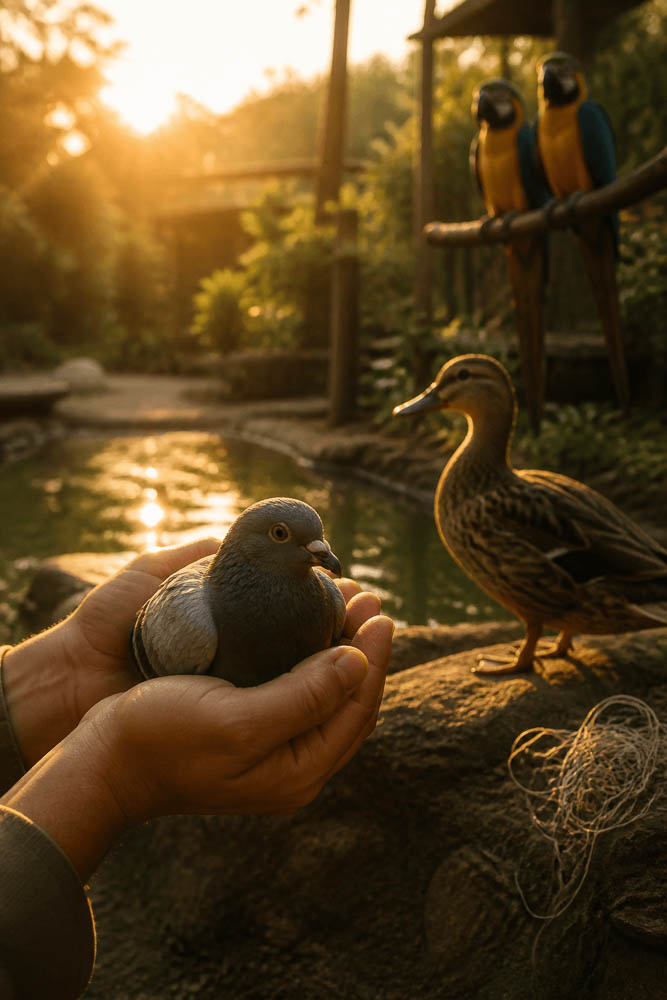
A rescuer gently tends to an injured pigeon during treatment. Not every bird can be returned to the wild, but each one deserves the best possible care and a life free from fear.
Illustration: AI-generated for Ruffled Feathers Parrot Sanctuary Inc.
I thought I was collecting a day’s worth of social media posts. Instead, I found a single story I hadn’t realized I was telling.
When I first sat down to assemble this edition of The RFPS Chronicles, I thought I was simply gathering together a day’s worth of social media posts.
A rescue here.
A sanctuary update there.
A wildlife lesson tucked in between.
But as the pages came together, something unexpected happened.
Those individual moments stopped feeling like separate stories.
They became one story.
A story about compassion.
Not the loud kind that demands recognition.
The quiet kind that changes lives.
It was there in the stranger who refused to walk past an exhausted duck tangled in fishing line.
It was there in the people who stopped to help a frightened baby pigeon after tragedy struck.
It was there in the volunteer who quietly gave up part of the day to help an animal they had never met.
It was there in the laughter shared over parrots who somehow manage to make even ordinary afternoons unforgettable.
Different animals.
Different circumstances.
The same choice.
Someone cared.
That simple decision echoes throughout every page of this edition.
Every story in these pages began the same way the very first page promised: with compassion, and with someone who noticed.
The Stories Behind the Stories
One thing I’ve learned over the years is that every rescue has two stories.
There’s the story everyone sees.
The photograph.
The video.
The successful release.
The happy ending.
Then there’s the story that usually goes untold.
The person who made the phone call.
The volunteer who changed their plans.
The veterinarian who stayed a little later.
The donor who unknowingly paid for the medication that made recovery possible.
The hours spent cleaning carriers, preparing food, washing towels, answering messages, and getting ready for the next emergency before the current one is even over.
Those moments rarely appear in photographs.
But without them…
The photographs never happen.
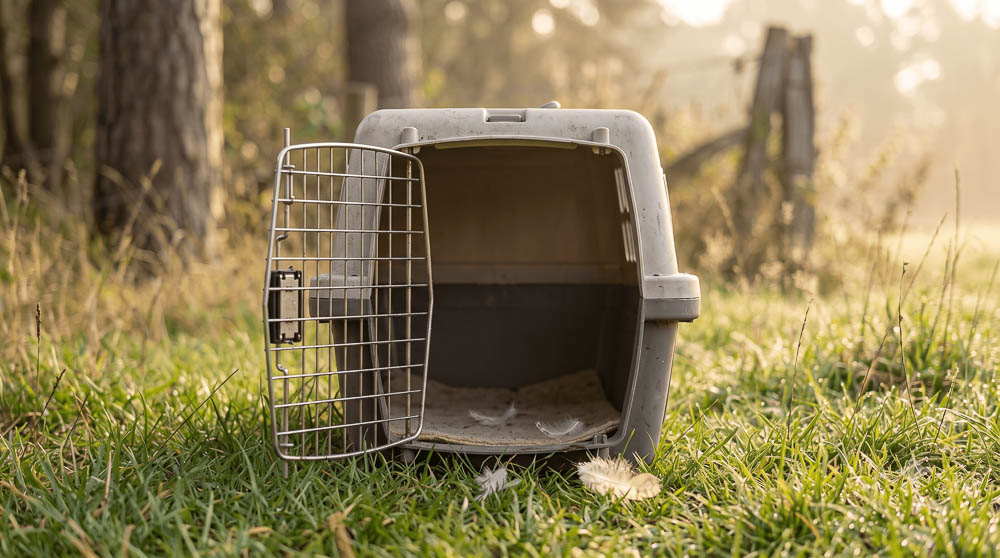
Illustration: AI-generated for Ruffled Feathers Parrot Sanctuary Inc.
Why We Started The RFPS Chronicles
Social media is wonderful for sharing moments.
But moments disappear.
A post that reaches thousands of people today slowly slips out of view as tomorrow brings new stories.
That doesn’t mean those rescues become less important.
It simply means they deserve a better home.
That’s why these Chronicles exist.
Not to replace social media.
To preserve it.
Years from now, I want someone to be able to open this edition and experience these stories the way they unfolded.
To understand not only what happened…
But why it mattered.
Because rescue history deserves to be remembered.
Social media is wonderful for sharing moments. But moments disappear.
The RFPS Chronicles Continues with the Next Call
By the time you finish reading these pages, another rescue may already be unfolding somewhere.
A fledgling may be waiting beneath a tree.
A turtle may be trying to cross a busy road.
Someone may be looking at an injured bird and wondering whether they should stop.
I hope they do.
Because every rescue begins exactly the same way.
Someone notices.
Someone cares.
Someone acts.
The animal may never know their name.
But it will know the difference they made.
Thank you for spending part of your day with us.
We’ll see you in the next edition.
Somewhere tonight, an animal is waiting for someone to notice. Tomorrow, that someone might be you.
Someone notices. Someone cares. Someone acts.
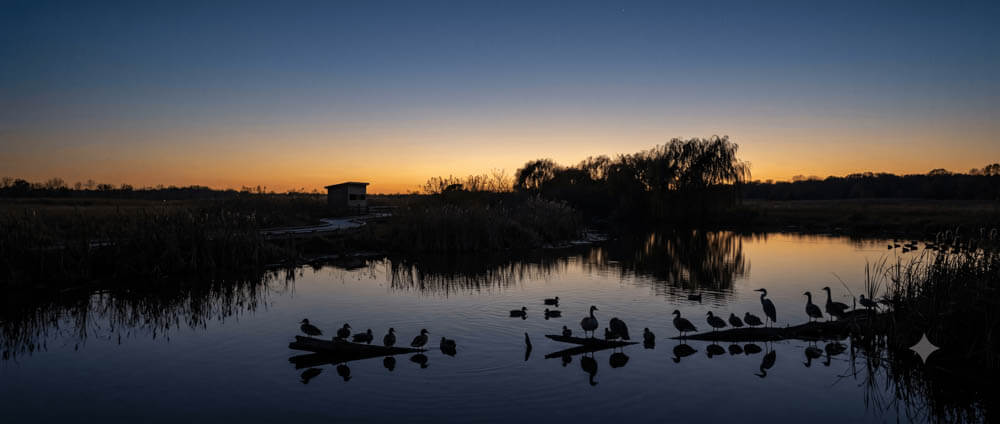
Back Cover
Until They No Longer Need Us
Every photograph in this Chronicle represents a moment that could have ended differently.
A duck that might never have escaped.
A goose that might never have eaten again.
A baby pigeon that might never have found safety.
A parrot enjoying another peaceful afternoon because someone showed up to care.
Those moments remind us that rescue isn’t measured only by the lives we save.
It’s measured by the compassion we choose to show.
Sometimes that compassion looks like stopping the car.
Sometimes it’s making a phone call.
Sometimes it’s volunteering for an afternoon.
Sometimes it’s sharing what you’ve learned with someone else.
None of those actions seem extraordinary on their own.
Together, they change the world for an animal that has nowhere else to turn.
Thank you for being part of this journey.
We’ll be here tomorrow.
Because wildlife doesn’t stop needing help when the sun goes down.
And neither do we.
Ruffled Feathers Parrot Sanctuary, Inc.
Hope takes flight for parrots and wildlife.
This edition was called “Where Compassion Begins,” and now you’ve seen where it begins.
Not in a headquarters or a headline, but in the split second someone decides not to look away.
That decision is waiting to be made again tomorrow, and the day after, in a hundred small moments you’ll never read about.
I hope the next one belongs to you.
And I hope you’ll be here when we tell the story of who else chose to stop.
The RFPS Chronicles is published by Ruffled Feathers Parrot Sanctuary, Inc. to preserve the stories, lessons, and history behind our daily work with parrots and wildlife.
Every edition documents real rescues, sanctuary life, educational outreach, and the extraordinary compassion shown by volunteers, veterinarians, donors, and members of the community.
© 2026 Ruffled Feathers Parrot Sanctuary, Inc. All rights reserved.
The Last Feather
The phone will ring again tomorrow.
It always does.
Somewhere out there, an animal is already depending on a stranger who hasn’t decided to stop yet.
Maybe it will be you.
Some of our related content:
Where Hope Takes Flight